Showing posts with label Democracy. Show all posts

Thursday, November 7, 2024

A reply to Charlie

Yesterday was, as I indicated in my previous blog entry a momentous day.  The aftermath of the election the previous day remains raw.  And I think emtions are running high, justifibly so as the gravity of the moment bespeaks a high sense of feelings.

To be candid, Facebook is my go-to social media platform and where I spend way too much time arguing, sharing, and so forth.  Yesterday it was a place of mixed messages and emotions as I watched and read what was there.  Among the things posted, later in the day, was Heather Cox Richardson's daily synopsis.  Heather is a History Professor at Boston College (https://en.wikipedia.org/wiki/Heather_Cox_Richardson).  She styles herself as follows on her substack feed:  "I'm a history professor interested in the contrast between image and reality in American politics. I believe in American democracy, despite its frequent failures."  Her post yesterday was no less informative than any previous, and as is my habit I often repost her synopsis (here is last night's post:  https://heathercoxrichardson.substack.com/p/november-6-2024).

My reply prompted a comment by Charlie Davidson, a former student and strongly held libertarian.  I think it is definately worthy of consideration as he is not alone in his convictions and thoughts:

"If you were surprised by this loss, you may not be as informed as you think you are. And this also speaks to an inability to understand WORKING CLASS people. Kamala was never working class and its also hilarious how much Hispanics and women shifted to Trump. So keep calling us sexist or racist or whatever, that just proves you don't understand Americans."

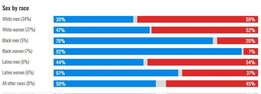
In reply I offered the following appending the image that follows):

"Charles Davidson I’m not surprised by the loss for Harris, it’s been a toss up for almost the entire race.  The magnitude of the break, that is different, although, it’s not far from a couple models that 538 did adding in the polling error typical from the last two rounds (which I was thinking were better likelihoods than what the spin was going around).


As for demographics, this gets at the reality (so far as we know it, percentage next to the demographic label is the percentage of the overall electoral that falls in that category).  I don’t have one that breaks it down along class lines.  Your point about working class and how they vote is, again, not surprising to me.  I’ve long said there’s a difference between working class and middle class, and that is too often been lumped together.  Most of the difference there is attitude and culture, but also economics.  This image shows that there’s a number of false narratives about Hispanics going around now, as with women generally, although that demographic (white women) was clearly misunderstood by the prognosticators.


What I don’t understand about Americans, rather clearly, is the depth that the majority are willing to accept the risk to our representative democratic experiment; the republic.  I have sworn an oath to defend the constitution, and the republic that it defines, having served in uniform for over two decades.  Inherently that makes me a minority, as less than 2% of Americans can or have been willing to do that.  I am, admittedly, skewed in my thinking in that regard, as I’ve taken it seriously and know what is really in the constitution and what the republic stands for and what it does not (a great example was how I, one time, revealed to you how, what you thought ought to be forbidden under the constitution, was actually an explicit power granted to the federal government under the constitution).  The rather poor civics education in our country is something I’ve spoken/written about, but to me it seems much worse than I’ve thought.  And I think it’s not just knowledge, it’s the attitudes that have emerged about the republic that have been foisted and believed, not only thanks to hyper partisanship, but downright lies and misinformation thats been bought in as well (increasingly by hostile foreign powers).  It’s really stunning and problematic if you hold to a political center based on the defense of the constitution and how it’s enshrined.  It’s also problematic when you consider the true impacts of the losses that come with having the republic falter, which most people take for granted won’t happen or blissfully ignore that it’d happen to them (again based on my experiences, especially having been to other places in the world and having been a longtime student of history).  I clearly see the risks as too great to jettison the republic, most Americans do not.  I’ve got to get my head around that.  Americans aren’t as values based as they purport to be, at least about the democratic governance experiment that came out of our revolution.  Clearly there are other motivations and drivers that supersede the republic’s defense which I thought was held more deeply in regard than it is.  I’ve got to get my head around that more and I’ll submit it is bothersome even as I am aware it’s not entirely unique to our political history."


I don't have more to add to this post, other than to say this remains tied to my post yesterday and where I am eager, for the sake of the republic, to defend it as I have sworn to do.


Wednesday, November 6, 2024

A republic, if you can keep it


I start the writing of this post in the early hours of 6 November 2024, a date that shall, I’m quite certain, be studied for many decades to come.  While the vote totals are not all in from the election balloting the previous day, it looks as if Donald Trump will return to the Presidency for a non-consecutive second term.  This may yet be overturned, but seeing where things stand with him leading in the returns of all the remaining states, it seems he and his supporters have put together not only an electoral college win, but also, for the first time ever, a popular majority win.  A truly stunning turn of events.


In 1787, as the constitutional convention was closing, James McHenry, in his published journal, records a conversation between Mrs. Elizabeth Powell and Benjamin Franklin (styled as Doctor Franklin in the foregoing):  “A lady asked Dr. Franklin ‘Well Doctor what have we got a republic or a monarchy’ – ‘A republic ‘ replied the Doctor ‘if you can keep it.’” (https://blogs.loc.gov/manuscripts/2022/01/a-republic-if-you-can-keep-it-elizabeth-willing-powel-benjamin-franklin-and-the-james-mchenry-journal/).  To be succinct, we are at a moment where that latter part will be in question.  The return of Trump to the presidency will stretch and challenge whether the republic can and will hold.  This is not a question of if or if not this is true, we have the evidence of his previous four year term to show it is true.  The question is to what degree and how badly will it be.


And that is the state of affairs that the American voters appear to have been willing to risk, if not outright endorse.  Back in the summer of 2016, I wrote about the phenomenon of Trump (http://backusec.blogspot.com/2016/07/the-trump-phenom-abridged.html), which has remained evergreen in its assessment of the nature of the supporters of Trump.  The exception being that the “feeling” aspect that drives the movement is increasingly, and almost entirely, divorced from facts or realties.  It is instead built on a set of perceptions and mythology that is repeated incessantly and through unfiltered mechanisms based on the pomposity of Trump.  Despite his being held liable for sexual assault and rape (to the tune of tens of millions of dollars)  and being convicted of a felony, his spin of it being a sham court, unjust persecution, and election interference (all of which are fundamentally untrue) are believed by a significant number of people.  Many of which are parroting or even going further in embellishing the fantasy that’s been spun out, that he not only gets away with it, people feel aggrieved with him.  The depth of how well this has permeated was brought to full relief to me when a friend commented a few months ago in response to one of my posts.  In her mind, the republic was already dead and there was nothing left to salvage from it (despite the fact that she lives in a world, which is clearly taken for granted, where the entire economy is backed by the full faith and trust in the republic she calls dead).  And the apparent result is self evident, the American voter is either wired into this dystopian version of the world or at least tolerant of it enough that they voted to put him back in office (despite well knowing the likely result).


As the first term of Trump’s presidency ensued, I prognosticated that it was going to be a chaos driven mess that was going to pull us in the wrong direction, as we had to contend with serious and potentially devastating challenges as a country both domestically and in foreign policy.  After I retired from the US Army in early 2018 it was clear that the direction was not good, but the guardrails were holding to keep the republic from failing in spite of the chaos that was beginning to be the signature of the administration, with policies issued by tweet and showmanship being the modus operandi over and against any sense of statesmanship.  There were significant accomplishments made, from the MAGA point of view:  a massive tax cut and reordering of the tax code, the appointment of a majority of solidly conservative (arguably reactionary) US supreme court justices along with scores of federal judges, a “phase 1 trade deal with China”, a bromance between Trump and Kim Jung Ill, etc.  Nevertheless, despite efforts to make our foreign affairs into a transactional system, our alliances were not fully abandoned, NATO held, and we did not fully concede to an isolationist position.  At home, repeals to the American Care Act (aka the health care act passed during the Obama presidency) failed, efforts to dismantle the civil service were thwarted, and within the Whitehouse itself, there were many who were reigning in excesses like trying to shoot protestors in the knees or using the military in domestic law enforcement.


This was, however, a serious period of back peddling and failing to address the big issues of the day, all in favor of creating political theater for entertainment sake at an unprecedented scale.  There was no infrastructure bill or serious effort.  There wasn’t any real effort to contend with entitlements in a serious way.  There was zero effort to curb spending on nice to do things and even a doubling down on wasteful efforts like the boondoggle that was and is “the border wall.”  The Afghanistan conflict continued, and instead of negotiating to leave on terms that would bolster what we had invested in that place, the Afghan government had to deal with an agreement between the US and the Taliban that put them in a horrible position; leaving the conclusion our involvement to be decided in the next administration without a real way to fix the problems.  There was no tangible effort to curb the effects of a changed global economy, and instead it was imposition of tariffs, a retake on NAFTA renamed USMCA that didn’t change the paradigm, and an era of easy cash that had hyperactive growth in the economy making it primed for a massive burst.  And, boy did that house of cards tumble in the face of a once in a century event, a global pandemic.


To avoid going on forever on the history of the first Trump presidency, it ended in devastating fashion.  Millions of Americans lost their lives to the COVID-19 outbreak, never minding the numbers globally.  The economy which was flying way to high for its own good, tanked massively putting many out of work resulting in Trump being the first president since the Great Depression who left office having lost more jobs than had been created.  The problems at the southern border never got solved (and arguably were left to fester), instead of quelling unrest and uniting the country, protests had only increased and gotten increasingly violent, and we had done nothing functionally to build a bulwark to deal with a rising China, stop Iran from getting the bomb, keep autocrats from getting their way, or strengthen our stance with allies so as to have a joint vision for security and prosperity at home and abroad.  People in America voted clearly that he had failed, and it was time to end the madness.  However, then, came January 6th, 2021, when he incited an armed insurrectionist mob to storm the Capitol of the United States, carrying his banner, to stop the certification of the election that unseated him.  Unwilling to ever concede or acknowledge his election loss, this was all fueled by a massive lie that perpetuates to this day.  He was impeached for the second time for this traitorous effort (the first was for his acts pertaining to Ukraine and the 2016 election), but as the machinations of the Senate allowed, he was not removed mainly on a technicality (making him eligible to run again).


Because of that, despite the facts and the realities of the failures of the first term of office, again he is most likely to be making residence at 1600 Pennsylvania Avenue, Washington, DC in January 2025.  Yes, the republic had not failed, but it was haggard and beaten.  Again, despite the post presidency revelations (e.g. mishandling and concealing his keeping of classified documents, efforts to get the Georgia election results overturned, and the details of his part in the January 6th attempted insurrection, among other things), the American people have elected for the first time a traitorous felon to the Whitehouse.  I have heard it many times that we need to trust the “wisdom” of the American people as the express their will at the ballot box.  I’ll be blunt, I absolutely do not, because, increasingly, it has nothing to do with wisdom.  Rather it has much more to do with the feelings and myths that we tell ourselves over and against realities we too often do not want to see.  As I wrote on social media, the election of Joe Biden in 2020 to the presidency was merely the first step in fixing the underlying problem we have in America (an important one, but still only the first step).  As is in evidence now, it was not enough to remove the head from the snake that is Trumpism.  No, we needed to address, head-on, the grievances of the electorate with a straight talking, clear and truthful effort.  Biden did some of that, in that we finally got an infrastructure bill, we took action on high tech industry efforts, we curbed the results of the post-pandemic supply chain and Ukraine war driven inflation, but it was not enough.  Biden needed to anoint his successors to keep the work going well before the spring of this year.  He needed to find a way to confront the lies and fabrications being spewed by the Trump machine.  He needed to recognize he couldn’t be the front man for any longer than the first two years and that he needed to bring home traditional republicans to a coalition that could weather the upsurge of the MAGA-ites that was inevitable to occur.  Yes, there are problems in our republic that need fixing, but Joe didn’t get at those core issues, at least enough and with the plan to get through the long slog it needs to take to get to the other side.

So now, we are looking at the question asked akin to that of Elizabeth Powell.  America will we become something other than a republic?  Massive deportations, destruction of our institutions, and much more is promised by Trump.  Those that served within his last administration, who provided some sense of guardrails, have eschewed him and what he stands for.  Loyalty to him and his fantasy world is the only mark used to judge who he lets into his circle.  So who will be the voices of reason?  It is absolutely true that Trump poses a potentially unfettered risk to the republic, he demonstrated that before and has now promised to exact revenge on any that dared to have stood in his way.  This is what was voted for, this is what we were promised.  Are we ready for the republic to end?  Can we keep it?  I have deep fears that we will not.  I have sworn to protect the constitution of the United States, and I can do no other.  Today is a day where historians will look back and ask why we chose this road.  More so they will see it as an inflection point for the unfolding story of what American became rather than what it was.


Wednesday, October 4, 2023

The McCarthy Era and Liberum Veto

Back prior to the 2022 US midterms, many warned that if the Republicans won the House of Representatives, given our current state of politics, they needed to win big.  Otherwise, Speaker-to-be Kevin McCarthy was going to have an ungovernable caucus to contend with, should a minimal victory come to pass (https://www.latimes.com/politics/story/2022-11-09/gop-inches-toward-control-of-house-but-narrow-majority-would-complicate-mccarthys-speakership).  And it seems such prognosticators were proven 100% correct on the evening of 3 October 2023, when the Speakership, for the first time in our nation’s history, was vacated (on a vote of 216 to 210, 8 Repubs joining 208 Dems).  This was brought on, from a procedural point of view, by a change in the House rules, made as a concession in order for McCarthy to ascend the Speakership back in January this year.  As you’ll recall, it took over a dozen votes for McCarthy to gain the gavel in the lower chamber of our legislature, a chaotic affair not seen since the time prior to the US Civil War (https://en.wikipedia.org/wiki/January_2023_Speaker_of_the_United_States_House_of_Representatives_election).  Essentially, McCarthy codified the mechanism of liberum veto that lead to his downfall.  Yes, Representative Matt Gaetz is without question a gleeful political nihilistic arson-terrorist, but McCarthy, in agreeing to and implementing this rule change, put everything in front of him for the inferno to be started, including literally handing Gaetz the match.


The last 8 years have seen a lot of firsts in our country, most of them not good.  Electing, as President, our first ever person who had never held public office or an appointment as a federal officer before, was disastrous, for example.  But history, if we look at it, could have well predicted the eventuality of Tuesday evening (as well as much of our recent past debacles).  In 17th century Poland, the Polish-Lithuanian Commonwealth’s parliament had a procedure called the “liberum veto” that allowed any one member of the body to object to any legislation, as the body required unanimous consent to agree to any measure.  It eventually even got to the point where the exercise of this right of veto was sufficient to end the parliament altogether (https://en.wikipedia.org/wiki/Liberum_veto).  To make a long story shorter, this ostensibly very liberal, uber minority protection clause, was the cause of the massive political anarchy that brought down one of the most powerful powers in European history to the point that, Poland, after the third partition between Russia, Austria, and Prussia, ceased to exist.  


Looking at events on October 3rd, 2023, using the lens of this knowledge of the past, makes it clear that this is history striking a very horrible rhyme with itself.  What’s worse is that if you look back at this history, you’ll see that once Liberum veto became established, it became impossible to undo, even when it was well acknowledged that it was destroying the very country and system that had established it in the first place.  So too, most likely, here.  Once a right or privilege is given, even when it’s clear it’s poorly defined, leads to really bad downsides (making any upside seem small in comparison), or is literally killing people, pulling it back is nearly impossible.  Will the House change its rules to make it harder for members to vacate the speakership?  I doubt it, seriously doubt it.  This immediate result, McCarthy loosing his speakership, was entirely predictable(https://www.thenation.com/article/politics/maga-wave-midterm-elections/).  But what’s becoming clearer, is that the longer term trend, of the unraveling, weakening, and potential demise of the US democratic republican experiment, is also becoming true as well.


The founders, looking back at history, especially the Roman republic, were very concerned that republics had repeatedly failed because of the inability to control the various powers and interests at play in politics.  Some worried about government overreach which would result in an autocratic state.  Others worried about naked self interests destroying the fabric of society resulting in anarchy.  Others recognized the cultural and ethnic diversity of the nation could either be harnessed for good or for evil purposes.  And some even saw that the cognitive dissonance needed to have slavery exist within a free society as a massive cancer that would potentially rip the country in pieces.  The point being, they knew they had to work hard to create a republic that could address these challenges and the challenges that the future would bring.  They looked back and tried to use the examples of history to avoid the failures and hold onto the successes of democratic republicanism as the country emerged.  They knew the first attempt, the Articles of Confederation, had failed, and so created a Constitution that would supplant it and help us form “a more perfect union”.  They were wise enough to know it needed to change, and thus put in clauses to amend it and, if needed, revise it substantially (convention clause).  It isn’t perfect, it was intended to be more perfect, but we need to recognize what is happening with a long view, much like they did.


What is true now is that it’s clear the forces of nihilism, self interest, and, I’ll say it, evil have made it clear that they are more than willing to see the republic fail to get their way.  The Gracchi are alive and well, and they are more than ever willing to smash the clay jars in the forum to get their way; votes, or system, or anything else that might get in their way (http://backusec.blogspot.com/2017/08/the-gracchi-reborn.html).  GEN Mark Milley, in his retirement speech, offered that US Military personnel “… don’t take an oath to a king, or a queen, or to a tyrant or dictator, and we don’t take an oath to a wannabe dictator.  We don’t take an oath to an individual. We take an oath to the Constitution, and we take an oath to the idea that is America, and we’re willing to die to protect it.  Every soldier, sailor, airman, Marine, guardian and Coast Guardsman, each of us commits our very life to protect and defend that document, regardless of personal price.  And we are not easily intimidated.”  (https://www.politico.com/news/2023/09/29/milley-farewell-speech-trump-dictator-00119130).  So as much as these forces of evil are arrayed against the republic, there are those that are willing and able to proverbially right the ship.  We need more of them, and most of them need to be those out of uniform.  In my mind, yes, Matt Gaetz actually lit the match he was given, he is our Gavrilo Princip assassinating the Austrian Archduke (http://backusec.blogspot.com/2016/07/the-trump-phenom-abridged.html).  McCarthy, Trump, and all of the blatant power seekers of the past and present are to blame for creating the powder keg that we, who elect them, have created for ourselves.


What’s the answer?  Well there’s several ways this can go, if we look at history.  Certainly there are the violent options of uprising, revolution or violent crackdown, all of which are bad options both in the short term and long term as learned in 18th and 19th century France, Russia, Austria, and so forth.  There’s the ever slow unraveling of the republic and Balkanization that can occur, sometimes violent, sometimes peaceful, but never clean.  There’s the option that the Romans took and simply resolve to first resist change to the point that it the sclerosis sets in and eventually plutocrats control things to the point that they work to create accommodations, and resulting factional strife, with an eventual autocrat emerging as “the winner” in a system of patronage and spoils.  Or we can choose other paths, like having an enlightened political force/leadership come to make the needed reforms to revitalize the system (e.g. Lincoln, Roosevelt, etc.).  Or to have a groundswell of support giving majoritarian power to those we hold to actually fix the system instead of tearing it down: meaning we vote not for ourselves but for the future.  Or to use the mechanisms of the constitution, even reverting in some cases to earlier mechanisms (e.g. repeal the 17th amendment), to facilitate the tweaks needed to address the problems and forces that are making those problems worse.


The point being, we should be mindful of the lessons of history as we go forward.  Choose, as the founders did, from the things that will help us and avoid those that will destroy us.  Short term politics has the bad habit of not doing that and, worse, rhyming with the points in history that resulted in the utter demise of all that the idea of America stands for.  I, like GEN Milley, will fight to stop that from happening.  Will you?

Monday, August 28, 2023

How the Old Testament Fits in the Christian Canon


For some time now I have had a running debate with one of my beloved fraternity brothers, Joe Deutschman, on that poor mechanism for such debates called Facebook.  This relates to how Christians see, use, and/or understand the Old Testament, and its necessity as a part of the canon.  Joe, a non-believer, has several very ignorant misconceptions about this, and I again tried to enlighten him.  I have opted to change mediums, because the discussion on Facebook will not do us service.


The most recent give and take started with re-sharing of a post by Mark Rowden that I preamble as such:  “The apostasy of the literalist fundamentalist reading of the collection of books, letters, narratives, and stories we have come to call the Bible, continues to plague believers and especially nonbelievers.  Thanks for this reminder and explanation of the truth of the matter.”  Here is the post in question by Mark:  https://www.facebook.com/mark.rowden.12/posts/6569646289782477.


To that, Joe wrote the following:  “This is why I've never understood why Christianity keeps the Old and New Testaments together in one book. Given what the faith is professed to believe, wouldn't it make more sense to have the New Testament be "The Bible", the main text of the religion, and the Old Testament be kept around as a reference text?”


To this I provide an analogy to the relationship between the US Constitution and the corpus of English/British law that preceded it, to how the Old Testament relates to the New Testament as the progenitor and necessary context to understand the scriptures fully.  Eventually, Joe stipulates that, “We [Americans in the Constitution] included specific terms and concepts, not every single one. Nowhere in the US Constitution did we say "reference the Magna Carta for anything not explicitly covered here", which is exactly what Christianity did with the Old Testament - "If it's not directly contradicted in the New Testament, the Old Testament is still the [religious] law".


To this I have responded:  “Joe Deutschman where in Christianity does it say “if it’s not directly contradicted in the New Testament, the Old Testament is still the [religious] law.”?

Answer: nowhere. That is a completely wrong understanding of the place of the Old Testament in relationship to Christianity or scripture at large. Clearly you’ve got to spend much more time actually studying and understanding what is and is not a part of said faith and the place of the writ within them.

My analogy is exceptionally apt. There are those that have mistakenly disabused how the Old Testament is to be understood and used within Christianity. Those exceptions, however, doesn’t make that false understanding true. This is akin to certain people who hold to completely fraudulent understandings of the US Constitution, most recently as it relates to electoral college vote certification, for instance.”


At this point, Joe has most recently responded with the following:


“Maybe that's not how you view it or personally believe, but looking at it objectively for the religion as a whole you are wrong (and the majority of American Christians clearly disagree as well, given their political actions). Below is an image of the most common Bible used in the US. This is the formal "holy book" recognized as the foundation of the religion by the majority of American Christians. It is the book preachers use day-in and day-out for their sermons. Any verse from any part of the book. Today maybe they're preaching from the Book of Luke. Tomorrow maybe from Psalms. It is the book passed out to youth, it is the book kept in the pews. Absolutely nowhere is it written "second half is what matters, first half is just there for historical reference". No preacher starts a sermon with "today we're using a verse from the Old Testament, so it's not as important/literal/whatever as yesterday's sermon from the New Testament." The two halves are given equal credence in that book. Until Christian sects segregate the Old Testament and formally declare it to not be given equal credence to the New Testament, it will continue to have equal effect and impact.


Meanwhile, I have never once seen an instance of the US Constitution published with the Magna Carta alongside it. So no, the fact that the NT and OT are almost always published together, and the Constitution/Magna Carta are not, makes your analogy fail.”


It is at this point where I am picking up in this discussion with this post.


Joe,


Since you have decided to literally judge a book (or more accurately an anthology/compendium of books, letters, legends/myths/moral stories, poetry, histories, prophetic texts, apocalypses, and other literature) by its cover, I have had to turn to a medium that is more appropriate to respond.  What has become exceptionally clear to me is that while you hold this strongly held opinion, it is based on a false foundation.  I don’t blame you entirely, because popular culture has aided and abetted in this willful ignorance, but I just cannot let you remain as such, especially in a relationship where truth, caring, and being “of good heart” must prevail.  I will do this in a point by point manner related to your last response to me, so as to be forthright in how I approach this discussion.


Let me first start with your opening sentence, namely:  “Maybe that's not how you view it or personally believe, but looking at it objectively for the religion as a whole you are wrong (and the majority of American Christians clearly disagree as well, given their political actions).” So you are invoking what the understanding is of the Old Testament related to the New Testament “objectively for the religion as a whole”.  Well, let’s get straight what the make-up of the “religion as a whole is”. 


First, the religion as a whole has a population in excess of 2 billion persons globally.[1]  Of that population, 62% are part of Catholic or Orthodox expressions of the faith, with Protestants representing approximately 37% of the world’s Christian population, or about 740 million persons.[2]  Orthodox and Catholic expressions have some very specific ways that they understand scripture, especially as it relates to how the Old Testament is to be understood in light of the New Testament, as well as having large corpuses of extra biblical literature to draw on for specific teachings that are considered on par with the Bible (aka Sacred Tradition) that further aid in how this is done.  They also require, in their liturgies and in their preaching, that there be a reading from the Old Testament, a reading or chanting from the Psalms, a reading from the epistles (e.g. letters) of the New Testament, and conclude with a reading from the Gospels.  Guidance is clear that the process of speaking to scriptures by priests is to use the Gospel lesson as the primary guide to understand and ruminate on the other readings which are paired and sequenced for every service offered in a deliberate way in what is called a lectionary.  This lectionary is not optional and not open to modification on whims, excepting approvals by higher levels of hierarchy which require good justification.  Point being, just from this point alone, yea, there is a much more clear understanding that ay given word, phrase, story, etc. in the Old Testament is not “equal to” any given word, phrase, story, etc. in the New Testament, for more than half of the world’s believers, looking at it  “objectively for the religion as a whole”.


But to bring the point home even further, within the Protestant ranks there is less strict rules of the road, but even then, for the vast majority, they have a clear heuristic approach to the Bible that preferences the use of  the New Testament to interpret and understand the Old Testament, a mechanism often entitled “scripture interprets scripture”.  Most also follow what is called the common lectionary (akin to the Orthodox and Catholic, but leaving out certain non-biblical festivals and celebrations) that necessitate that heuristic being applied in preaching regularly.  As indicated by Pew Research, approximately 13.1% of the world’s Christian population (or 285 million persons) is “Evangelical”.[3]  It is in these ranks that you are finding the folks you are talking about that “…[t]oday maybe they're preaching from the Book of Luke. Tomorrow maybe from Psalms.”  And even within evangelical circles the approach can be more or less akin to what you’ve implied is that case, meaning that is it is a small minority that would even try to say that one should use the Old Testament as a manner to interpret the New rather than vice versa, “objectively for the religion as a whole”.


But, you then go on to cite and criticize within the American context.  If you look at that landscape, of the various groups with 1 million or more members (representing some 113 million American Christians), only 25.4 million America Christians could fit into the “Evangelical” bracket as you are using it (in a very liberal use of the term, meaning this is over counting the likely number that are).[4]  That is 22.4% of Americas, max.  Meaning that clearly, “majority of American Christians” don’t disagree with me in how the Bible is approached”.  But you have appended this with “given their political actions”.  Well that is an interesting statement, as this charts show, Christians in their political persuasion are more or less evenly split:[5]


Point being, that if you are implying that Christians, because in your estimation a majority, are using the Old Testament as a reason to prescribe radically reactionary policies, the data, facts, do not bear you out.  Rather, the data, facts, show that the vast majority get that the Old Testament is to be interpreted in light of the New Testament and used as the context to understand said interpretative responses and proclamations.  What you are in error about is what you see as a loud, galvanized, and very politically active minority that is punching over it weight in places like you live because they’ve brought along or have gone in league with non-believing conservatives that happen to like the “eye for an eye, tooth for a tooth” provisions in the Old Testament, even if they are not Christians themselves.


With that part settled, let me take on the next claim you make:  “Below is an image of the most common Bible used in the US [the King James Version]. This is the formal "holy book" recognized as the foundation of the religion by the majority of American Christians. It is the book preachers use day-in and day-out for their sermons. Any verse from any part of the book. Today maybe they're preaching from the Book of Luke. Tomorrow maybe from Psalms. It is the book passed out to youth, it is the book kept in the pews.”


First, I will commend that you indeed know the most common read version of the Bible in the US.[8]  But here is the thing, even at 31% saying they use the King James Version (KJV), over 61% use a different version.  Did you know that for the 51 million Catholic Americans, they utilize a different canon for the Old Testament than do the Protestants (and thus don’t use the KJV as a result)?  And for Protestant groups like Lutherans, Episcopalians, UCC, and some others that they have those extra books in the bible as “Apocrypha” or “Deuterocanonical” texts that are included as additional materials, akin to an annex?  And do you have any idea how many commentaries, exploratory discussion texts, or historical context books are available to help guide and inform preachers, never mind those that study or read the Bible?  And you’d be massively surprised to hear that the Bible volume itself is complete absent from most Catholic, Episcopal, and many Presbyterian and Lutheran church pews in the US, as the verses for the day are either printed in a “missal” or in the bulletin, for easier access during the worship services.


Point is yup, it’s a book in common usage, the Bible.  And yes it is “foundational”, but only as much as many other things in life.  Preachers don’t just rely on the text of the Bible itself, and use many other resources.  And, as I articulated above, most don’t get the choice either by mandate or by normative practice to choose what they get to preach on, as the lectionary is prescribed for them.  They don’t get to choose to preach from “[a]ny verse from any part of the book”, they have to wrestle with an contend with several verses that are meant to convey a thread and/or larger moral concept that can and does get drawn out from those passages, using a specific “lens”.


This brings me to your next claim that “Absolutely nowhere is it written "second half is what matters, first half is just there for historical reference". No preacher starts a sermon with "today we're using a verse from the Old Testament, so it's not as important/literal/whatever as yesterday's sermon from the New Testament." The two halves are given equal credence in that book.”


So this is where you are so dead wrong, again thanks to complete and utter biblical ignorance (to which I pray you actually read the Bible and see what it actually says instead of presuming to know what it says).  Let me start with what Jesus himself says about where the Old Testament, the scriptures of his time, and what it says about faith, life and more, in relation to what he, as the center nexus point, was to them.  When asked about the old Law, Jesus himself states how it is to be viewed: “‘You shall love the Lord your God with all your heart, and with all your soul, and with all your mind.’ This is the greatest and first commandment. And a second is like it: ‘You shall love your neighbor as yourself.’ On these two commandments hang all the law and the prophets.” (Matthew 22:34-40). As he made clear, the Old Testament strictures on particulars are not what matters, it is understanding the core moral ethic behind those strictures, centers on this very interpretation.[9]  For this reason, Christians are not to just read the Bible as if every part of it is equal, but we are to read the scriptures, especially the Old Testament, through “the lens of Jesus” (e.g. read it as if we did so through Jesus eyes).[10]  And later writers push this even more, that “when there seems to be a conflict between Old Testament laws and New Testament principles, we must follow the New Testament because it represents the most recent and most perfect revelation from God (Hebrews 8:13, 2 Corinthians 3:1-18, Galatians 2:15-20).”[11]  This article in particular lays this very well, with extensive citations: https://www.christianbiblereference.org/faq_OldTestamentLaw.htm.  Paul of Tarsus, in particular, articulates much of this very important understanding in his letter to the Romans (Chapter 2 through 13:10) where he comes back to the same summary that Christ himself offers in the quote above.


Lastly, you stipulate that “[u]ntil Christian sects segregate the Old Testament and formally declare it to not be given equal credence to the New Testament, it will continue to have equal effect and impact.”


So, succinctly, we (Christians) already “segregate the Old Testament” (its in its own section and distinctly understood in the canon as a separate and distinct).  Jesus himself declared it to “not be given equal credence to the New Testament” (in that he declared he was the one that was the ultimate interpreter of the Old Testament for all times (and was ultimately killed for making such bold claims), and the New Testament is a recording of his proclamations and life as well as letters then went on to give further heft and depth to that declaration).  So bottom line, you simply have an erroneous assumption or a great strawman you have created for yourself to bluster and beat on.  That strawman is that you continue to believe that Christians, give equal credence and thus a resulting “equal effect and impact” between the two Testaments in the Bible.  That simply, as demonstrated, not just by my opinion, but the statements by the religion’s very founder and further extensively cited works, that you are wrong to continue to hold this opinion.  This is an objective analysis of what the religion of Christianity actually says about itself and its “holy writ”.


Lastly, and as a complete rabbit hole you seem to want to go down on this topic, I actually have a book somewhere that has numerous documents foundational to liberal constitutional republican democracy that included the Magna Carta along with things like the Treaty of Westphalia, up to and including the US Constitution (it admittedly skips over a bunch of things, and is a rather incomplete text/anthology/compendium in that regard).  But the fact they are in one printed book or not, was not the point I made in my analogy.  The analogy was how English/British legal and governmental traditions and concepts (among them the Magna Carta, but a whole host of other things too) were necessary and a full part of how we understand the US Constitution, the Declaration of Independence and much more; to the point that SCOTUS justices continue to use case law and decisions in pre-independence courts in contemporaneous decisions (e.g. Dobbs).  Your utter fixation and fetishizing on the fact that the Bible publishers have conveniently put into one volume the precedent/background/contextual documentation for the latter part of the book instead of separating them physically, has led you to a) a bad strawman understanding of the biblical corpus and b) falsely understanding the very parallel comparison I made to our foundational documents.  Yes, most folks don’t try to put in one volume the better part of western political thought/jurisprudence from Justinian’s Codex to Four Freedom’s Speech by Roosevelt, because that would be one massive book that wouldn’t be humanly possible to pick up.  In the case of the Bible, however, one can do so, but it doesn’t mean that there’s equal credence to each part or that there isn’t an interpretive aspect of how you read the older part relative to the newer/current understanding any more or less than we do so in our current socio-political context.  But again, this is a sidebar intended to help you understand how Christianity understands the Old Testament as it relates to the New Testament, and not to get into a rabbit hole debate of whether the Magna Carta was ever printed in the same physical book as the US Constitution or whether there is an explicit reference to the Magna Carta as a whole in the US Constitution or other foundational document, even as we still hold fast to principles that originate in that 13th century document.


So with all this, I hope I am putting to bed some serious misunderstandings/ignorance that has pervaded our conversations on this topic.  I ask you just get over the “because its in one book, they are equal things” false presumption about the Old and New Testaments in the Bible, as the vast majority of Christianity understand its holy scriptures.  Yes, there are those outliers that are akin to the Pharisees who fall back into the trap of emphasizing the old law found in the Old Testament, over the explicit directives of the one they profess to follow.  That is why I have come to call them pseudo-Christians, because they use the labels of what Christianity uses, but applies them in the opposite way from what they are often explicitly meant to mean.  You may be around a lot of those folks and I will be blunt that they are over boisterous and over hyped (often because of the way it sells in the media).  But that doesn’t make it the mainstream, majority or even right understanding if you actually engage with the texts themselves.  You really need to do so, engage with the Bible, if you are going to continue to claim to be making an objective claim about a religious group that you are not a member of.  I can promise you that reading the Bible will not force you in any way to believe what is written or the God that is being discussed and struggled with to understand.  You may opt to, but you may also, like Dr. Bart Ehrman, remain an atheist/agnostic, but with a much more educated appreciation for Christianity and the various claims made within and without that religion.


Thanks.


IUAT,


Erik


[2] Ibid.

[3] Ibid

Sunday, April 9, 2023

Avoiding Lobotomy - Again


As a junior officer in the US Army, and commonly spoken in the undercurrent among both Non-Commissioned Officers (NCOs) and junior officers alike, is the “Field Officer lobotomy”(https://www.reddit.com/r/army/comments/v5taom/majors_whats_wrong_with_you/).  This is the thing that happens, somewhere in the development of an officer, typically when they are a Major, when they seemingly forget the basics of how the Army runs, and get lost into some rabbit hole while stuck in the long period between company command and battalion command.  It’s as if we just loose sense of what is “common sense” as well as being grounded in (and with) the very challenging realities of troops at the company level and below.  It’s as if all the staff and broadening “special assignments” time you spend puts you into some esoteric death spiral.  Sure you’re smart or capable, etc, but you’ve become this amorphous blob of uncertainty, indecision, and constant incapability because you’ve lost that command touch.  The vast majority of officers succumb at some point, as if they become “company men” or “women”, and accept the utter stupidity and core failings in the systems instead of seeking to work to challenge them and make for better systems or simply level with folks about the absurdity of it all.


In my military career, I worked really hard, I mean really hard, to not get/have said lobotomy.  Part of this was done by not taking the “normal path”, by eschewing just going with the flow from above as a way to get ahead.  Sure I didn’t run away from the core traditional command assignments (company and battalion command), but I found a way to do things that were impactful and as pragmatic as possible, in between.  That said, when it came to late 2016 and what I was going to do as I reached 20 years of service, I decided that micromanaging whether Johnny Joe or Jane soldier went to their dental appointment as a the way I was being measured as a commander in the Army Reserve, was ludicrous.  While it wasn’t the only reason to opt to decline a full command assignment (medical, career, and family reasons were more prominent), avoiding becoming lobotomized was also on the list.  Soldiers who served with me can tell you how successful or not I was at that task.  By summer 2017, however, I was heading to retirement, lest I succumbed.


So I am now on the cusp of yet another one of those “lobotomy” points.  In 2014 I went to the “dark side” in my career in the AEC (Architecture/Engineering/Construction) world:  I became a full time professor.  This said, I did so in a fashion that was atypical; I did not possess a doctorate.  In academia, these days, holding a PhD is normally the minimum prerequisite for such a role.  But instead I was hired to be a full time instructor and Director of the much more pragmatic Construction Engineering Management program at my alma mater, Clarkson.  If we look back at the history of engineering education, it was not until the 1970s that it became common that those serving as professors held doctorates.  Rather, it was more critical, nay the minimum prerequisite, that you had experience and knowledge that came from practice, demonstrated through licensure and robust professional credentials otherwise, rather than a having a background primarily as a researcher.  At Clarkson in particular, who’s motto is “a workman who needn’t not to be ashamed”, it was very common/valued that most faculty were consultants on the side and had a large portfolio of practical experience before and during their appointments.  Academia, for a variety of reasons, has turned to become research first, practical knowledge second, as the resume required in most settings.  And akin to the above undercurrent in the Army, it’s pretty much the unwritten rule that PhD means you have “pilled high and deep” a wall of theoretical knowledge that makes you lose the ability to have common sense or be grounded in the practical aspects of life.  And that stereotype is way too often more true than false, including a number of my colleagues in my department and beyond.


As I said, I am on the cusp of crossing that PhD line.  Not counting my chickens before they’re hatched, I still have to figure out how to get this last course done and finish the edits to my dissertation by the end of April, but the light outside that tunnel is very bright at this point.  So, if that happens, it’ll be Dr. Backus, fitting in with the crowd that is academia.  Now, strictly speaking, I did not have to pursue this.  I am a Professor of Practice at this point, something academia is finally realizing is needed; not, therefore, requiring a doctorate.  That said, there’s still a barrier to those without one to academic leadership (as was put by one person, “Erik doesn’t have a PhD so he can’t become chair, and shouldn’t remain as XO of the department”).  As I’ve seen time and time again, I’m more or less convinced that the fetish academia has with research, and the normal track for preparation and promotion for professors, is neither good nor healthy long term for the greater academy.  Running a lab, doing fundamental research, and publishing papers, does not prepare you well for become a leader of a department, school, college, etc.  And the things that are needed (eg organizational management & training, practical knowledge, leadership skills, etc.), are seen as almost anathema to gaining tenure and promotion (distractions, as one colleague put it).


So here am I, at that crossroads, about to become “one of them”, a “true academic”, with a doctorate and all to prove it.  I have no intent nor do I desire to work to gain tenure, expecting to remain a Professor of Practice through to retirement (although, I’d be very welcome, many years hence, to be considered for professor emeritus status, should that come about).  I made this pursuit, however, because it will open the doors to more senior leadership academically, given the current way things work, and it will alleviate my rather constant requirements to correct students from referring to me as “Doctor Backus” when I don’t have one.  I have always been a deep and big thinker.  I love learning, I remain ever curious and interested in expanding knowledge.  So I am not allergic to research (there’s parts of it I really like) and have been doing research even as far back as my Masters and in other roles in the military and when I was a practitioner in facilities organizations.  But I really think studying the ability to generate electrical power from lobsters (https://improbable.com/2013/02/06/renewable-power-source-search-lobsters/ ), while novel and cool, is utterly impractical and I am really not that interested in it.  I’m not saying that there isn’t a need for researching such things if they can lead to some real breakthrough, but it’s not my bag.  And to that, I hope it never becomes “my bag” as I stay rooted in the much more pragmatic, like making sure my students actually know how a toilet works, have had the experience of actually hammering a nail, as well as being able to do structural analysis, understand how to do concrete batch designs, size heating and cooling equipment, and build safer, better, and more resilient/sustainable infrastructure & buildings. I just do not want to be lobotomized away from what my experience and continuing practice allow me to do to bring value to my students, in the immediate sense, and through them, for the broader AEC community as a result.


I am going to say, hitting this milestone is something I remain sheepish and humble about.  The resume, so long as things finish as they should, will now list getting a PhD in 2023 (long removed from my Masters in 2004, so a late return to getting a terminal degree).  I will remain a bit of a unicorn, not fitting in exactly and pushing back against the consensus on what the broader academy needs to look like to remain relevant.  I do not believe one can be “over educated” as some seem to think happens here, when you’ve done a pursuit for a doctorate.  But I do get that we cannot and should not stare down our noses or exhibit the too often seen elitism that comes being in an academic ivory tower (evidenced just this week as senior academics poo-pooed the idea that a long-term decades-experienced, successful senior manager in the AEC world was not capable of teaching a masters level course in the “business of construction”, because he lacked an advance degree in business).  And I think engineering education, in particular, needs to return more to the practical, hands on, even trade skill training and education, that keeps us rooted.  I just don’t want to fit the moniker, I don’t want to be unable to relate to, empathize with, and understand the plumber, carpenter, iron worker in the field.  To me, being at the top of what I do means I help tomorrow’s construction (and, more broadly, AEC) leaders, grow in ways that brings better solutions than we come to today, working together and respectfully across backgrounds and experiences.  I just can’t succumb to a PhD lobotomy, in other words.  To that end, I hope those around me keep me grounded accordingly.