Showing posts with label Civics. Show all posts

Wednesday, August 5, 2026

Cresting the Summit of the Mount for a Second Time – Still a Thrill


This afternoon I received news that literally got me leaping out of my chair in happiness; we did it again!  You ask, what did we do again?  Achieve Gold, LEED for Communities Gold for the New York Olympic region.  If you have not read it, you may want to go back and read the post I made on 15 September 2019:  https://backusec.blogspot.com/2019/09/going-for-gold-and-making-it-my-our-new.html.  Once you have, you will get a large part of the background on what this meant then, and even more so now as we accomplished a full recertification of the same community using the most up to date version of the LEED for Communities rating system, achieving the same certification level even as it required us to meet even higher standards and having an even more robust submission.  As I wrote in this email to many today, this is a significant and summit type moment:


“Mayor Devlin, Supervisor Preston, Former Supervisor Doty, LPCSD Superintendent Seymour, ORDA CEO Walden, & Clarkson President Larson,


I am proud to relay to you the news below regarding the New York Olympic Region being re-ecertified at the GOLD Level of the LEED for Communities rating system.  This is a significant accomplishment for your community and represents your leadership as a sustainable and resilient community among the top across the globe.  It also is an acknowledgement of much more than just a certification effort, but a journey that your community has been on for decades.


As you know many community members have been a part of this effort, inclusive of a steering committee representing the town, village, school district, and ORDA (esp. Dean Dietrich, Marc Galvin, Haley Breen, Jackie Kelly, & Tammy Morgan).  Supported by ORDA's funding, and relying on undergraduate students to do the heavy lifting, we embarked on the recertification journey as part of Clarkson's Adirondack Semester in the Fall of 2023.  While it has taken longer than we expected, we achieved the goals we started out with in this effort to "Go for Gold" again; following up on our initial Gold level certification in 2019.  What has been great is how this has paralleled the Town & Village comprehensive planning efforts, ORDA's program development, community sustainability efforts through the school and elsewhere, and so much more while we have pushed forward on this global third party validation of your efforts.


I wish to give a special thanks to Ms. Maria Suffredini (EnvS&S, '25) and Ms. Rochelle Daniels (EnvE '26) who were the primary members of the student certification team pulling together our final submission and staying through to the end of this process.  I believe this is the first ever recertification of a community to LEED recertification standards by undergraduate students anywhere in the world.  I also want to thank the multi-institutional Sustainable Holistic Planning Systems (SHPS) research team who have been under-girding these efforts since 2018 with scholarship and support of students at both Clarkson and Syracuse University as well as now at the Universidad de Granada in Spain.  Finally, I want to thank the team at USGBC, especially Dr. Vatsal Bhatt and Ms. Hilari Varnadore, for their support on these efforts throughout.


We will await more details from GBCI as to next steps.  That said, I am sure you will be beaming as much as I was in hearing this good news.  Congratulations to all!!


Yours,


Erik C. Backus, Ph.D., P.E., LEED AP BD+C, ENV SP, FMP

Professor of Practice & Howard E. Lechler ’48, MS ’53, HD ’78 Endowed Director

Construction Engineering Management Program

Clarkson University”


As I indicated in 2019, and now say here, boy does it look great from the summit of the Olympic mountain.  I often have wondered what it is like to be a multiple gold medal winner, and now I can honestly say, the rush is almost identically the same.  And much of this has to do less with me, and much more, just like then, with the accomplishments of the students, the community, and all the other people that made this possible.  Like Herb Brooks might say, “now is our time”!  And Al Michales, to answer your question from 1980, yes, I do believe in miracles, especially those that strike more than once.


Akin to the original certification, this represents several firsts, namely this is the first recertification of a LEED Community that is:

1.      multi-jurisdictional, representing 4 different and collaborating municipalities and authorities

2.      an Olympic host site community

3.      a community with a tourist centric economy community

4.      entirely within a world renowned State Park, including parts of the Adirondack reserve

5.      executed by collegiate level students guided by faculty immersed in a non-urban community


I don’t know yet when the formal presentation will be, but you can be assured it will be all smiles.  And I very much look forward to being able to share this story for many years to come.  Not only did we help this amazing magical place achieve initial certification, we proved that because of those efforts and all they have and continue to do to make their community the best that it can be, they were recertified as a demonstration of all they have and will accomplish, together for the betterment of all.  I couldn’t be prouder of all involved and thankful for the partnership that has allowed it to happen.  This Gold has a very powerful glow to it, and I am so glad to have been in service to something much bigger than all of us could have imagined.  We did it, again!  So cool.  And as I ended the last post, now we are upward and onward to the next, amazing and sustainable goal.


Thursday, November 7, 2024

A reply to Charlie

Yesterday was, as I indicated in my previous blog entry a momentous day.  The aftermath of the election the previous day remains raw.  And I think emtions are running high, justifibly so as the gravity of the moment bespeaks a high sense of feelings.

To be candid, Facebook is my go-to social media platform and where I spend way too much time arguing, sharing, and so forth.  Yesterday it was a place of mixed messages and emotions as I watched and read what was there.  Among the things posted, later in the day, was Heather Cox Richardson's daily synopsis.  Heather is a History Professor at Boston College (https://en.wikipedia.org/wiki/Heather_Cox_Richardson).  She styles herself as follows on her substack feed:  "I'm a history professor interested in the contrast between image and reality in American politics. I believe in American democracy, despite its frequent failures."  Her post yesterday was no less informative than any previous, and as is my habit I often repost her synopsis (here is last night's post:  https://heathercoxrichardson.substack.com/p/november-6-2024).

My reply prompted a comment by Charlie Davidson, a former student and strongly held libertarian.  I think it is definately worthy of consideration as he is not alone in his convictions and thoughts:

"If you were surprised by this loss, you may not be as informed as you think you are. And this also speaks to an inability to understand WORKING CLASS people. Kamala was never working class and its also hilarious how much Hispanics and women shifted to Trump. So keep calling us sexist or racist or whatever, that just proves you don't understand Americans."

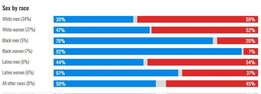
In reply I offered the following appending the image that follows):

"Charles Davidson I’m not surprised by the loss for Harris, it’s been a toss up for almost the entire race.  The magnitude of the break, that is different, although, it’s not far from a couple models that 538 did adding in the polling error typical from the last two rounds (which I was thinking were better likelihoods than what the spin was going around).


As for demographics, this gets at the reality (so far as we know it, percentage next to the demographic label is the percentage of the overall electoral that falls in that category).  I don’t have one that breaks it down along class lines.  Your point about working class and how they vote is, again, not surprising to me.  I’ve long said there’s a difference between working class and middle class, and that is too often been lumped together.  Most of the difference there is attitude and culture, but also economics.  This image shows that there’s a number of false narratives about Hispanics going around now, as with women generally, although that demographic (white women) was clearly misunderstood by the prognosticators.


What I don’t understand about Americans, rather clearly, is the depth that the majority are willing to accept the risk to our representative democratic experiment; the republic.  I have sworn an oath to defend the constitution, and the republic that it defines, having served in uniform for over two decades.  Inherently that makes me a minority, as less than 2% of Americans can or have been willing to do that.  I am, admittedly, skewed in my thinking in that regard, as I’ve taken it seriously and know what is really in the constitution and what the republic stands for and what it does not (a great example was how I, one time, revealed to you how, what you thought ought to be forbidden under the constitution, was actually an explicit power granted to the federal government under the constitution).  The rather poor civics education in our country is something I’ve spoken/written about, but to me it seems much worse than I’ve thought.  And I think it’s not just knowledge, it’s the attitudes that have emerged about the republic that have been foisted and believed, not only thanks to hyper partisanship, but downright lies and misinformation thats been bought in as well (increasingly by hostile foreign powers).  It’s really stunning and problematic if you hold to a political center based on the defense of the constitution and how it’s enshrined.  It’s also problematic when you consider the true impacts of the losses that come with having the republic falter, which most people take for granted won’t happen or blissfully ignore that it’d happen to them (again based on my experiences, especially having been to other places in the world and having been a longtime student of history).  I clearly see the risks as too great to jettison the republic, most Americans do not.  I’ve got to get my head around that.  Americans aren’t as values based as they purport to be, at least about the democratic governance experiment that came out of our revolution.  Clearly there are other motivations and drivers that supersede the republic’s defense which I thought was held more deeply in regard than it is.  I’ve got to get my head around that more and I’ll submit it is bothersome even as I am aware it’s not entirely unique to our political history."


I don't have more to add to this post, other than to say this remains tied to my post yesterday and where I am eager, for the sake of the republic, to defend it as I have sworn to do.


Tuesday, October 24, 2023

A companion post to “How to Honor Veterans and Military Personnel at Church – Appropriately, Compassionately”

 The Rev. Dr. Leah D. Schade posted via her Patheos blog “EcoPreacher” a very helpful guide entitled “How to Honor Veterans and Military Personnel at Church – Appropriately, Compassionately” (https://www.patheos.com/blogs/ecopreacher/2023/10/how-to-honor-veterans-and-military-personnel-at-church-appropriately-compassionately/).  The following is, what I hope to be, a companion to that effort, as I feel it missed a very critical voice in its discussion.  Before I do, however, I wish to note that Rev. Dr. Schade is among my favorite contemporary theologians, one whom I believe will go down as among the greatest in the early 21st century pantheon of theologians we know, especially within specifically Lutheran theological circles.  To that, I gave and continue to give her huge credit for weighing in on this in such a careful and thoughtful way.  I also acknowledge that in penning her post, she consulted with a number of other clergy, two of which were veterans.  This was good, for sure, and I certainly take that under advisement as I weigh in on this effort.

Let me begin this companion with the most obvious missing piece that I found in Rev. Dr. Schade’s discussion: the place of the soldier/warrior/veteran in the Kingdom of God.  To me, this is a critical and necessary precursor to any such discussion about how “we honor our veterans and current military personnel at church in a way that acknowledges their service without glorifying war or inserting patriotic displays in worship.”  Given that we are speaking in a specific Christian context, a first place to find such an answer is assuredly scripture.  To which, scripture is absolutely full of discussions of martial affairs.  Whether this be the centrality of Pharaoh’s military might in the Exodus story, or the conquest of Canaan by the Israelites, or the story of David from his slingshot of Goliath to his stealing of General Uriah’s wife (by the deliberate assassination of Uriah in battle), or dozens of other stories in the Old Testament alone, there is a lot one can and should consider about those who a part of any military effort as a warrior or however else they are named.  And we’d be very wise not to forget the prominence of military figures in the gospel itself, from the faith of the centurion to the soldiers casting lots at the foot of the cross, to the sentry who acknowledges that Jesus was truly the lord of all, to Pontius Pilate who condemned Christ to the cross as the means of his death (among other instances).  For that reason, I cannot commend strongly enough to your reading, comprehension, and understanding the treatise by Rev. Dr. Martin Luther entitled originally “Whether Soldiers Too Can Be Saved.” A copy of this can be found at this link: https://www.dropbox.com/scl/fi/la64z9n2hyax76bzpn825/15260000-WhetherSoldiersTooCanBeSaved.  This treatise, written to address this very issue when asked by a soldier themselves, is built on a solid scriptural foundation, remains exceptionally relevant today, and is foremost in my mind as I pen this companion.  I also think it can and should be used as a reference point in how we in the church, address veterans and military related holidays and those that have served.

While Rev. Dr. Schade spends the majority of her post addressing the fact that there are many veterans that struggle with their service, prefer not to discuss it, were traumatized by it, or have misgivings, and so forth, I will assert that the vast majority of us (noting here I am a veteran myself) have no such issues and are comfortable, proud, and readily identify with our service.  Yes, there is a serious problem with a segment of veterans that have bought into acceptance, if not outright full throated embrace, of white conservative Christian nationalism (noting the importance of the prefixes of “white” and “conservative” to Rev. Dr. Schade’s use of the term).  This can and absolutely needs correction.  I am not talking about those veterans, albeit I will address that as well later.  I am talking about the vast majority that have integrated back into civilian society and have taken on various roles from being teachers in our schools, to business owners, to members of various community groups, and most likely are a recognizable part of your congregation.  One of the biggest mistakes that can be made when it comes to addressing veterans, especially around specific related holidays, is to assume we are all broken pots that you have to handle with proverbial “kid gloves” or that we have had experiences that are so devoid of anyone else’s in society that we cannot be empathized with, if not understood.  While a declining demographic, per the 2020 census, we as veterans, represent approximately 7% of the population in the US.[1] If you look deeper however, the vast majority of veterans are aged 65 or older.[2] And given that many churches are “greying” in the US, as a percentage of the overall population, there are a much higher percentage of us in those age brackets.

Point being that, do not assume we have a struggle that is not there, assume that it’s not appreciated that you acknowledge our service to our fellow citizens, nor assume it’s unimportant that we may have a disproportionate impact on our communities, inclusive of our faith communities.  This is especially true around specific holidays.

So, to borrow from Rev. Dr. Schade’s approach, what can you do to address these issues? Beyond her very good suggestions, let me offer a few key points of advice:

  • Learn what the holidays actually are and are not.  Each of the national holidays have specific purposes that I find I have to habitually remind people about.  Memorial Day is a day for remembering and honoring those that have died in service of the county.  Yes, predominantly they are those that served in the military, but it also includes diplomats, astronauts, scientists, politicians, and many more.  So thinking that day is a day to especially thank a living veteran or service member for their service is a complete misnomer.  This is a day that often weighs heavily on those of us who have served in uniform as it is when we remember our brothers and sisters whom we witnessed die in combat or in other circumstances.  It can be greatly irritating to us to have you not understand the meaning of that day because, for me at least, it takes away from the importance on those whom should be recognized.  Similarly Armed Forces Day is a day for those currently serving in uniform, not for those who have served in the past (aka military veterans).  Veterans Day is for those who have served, whether that is a full career or a day, in uniform, so this is when you’re best to recognize all those living persons who are serving presently as well as in the past.  I’d also offer that September 11th (9/11) is an important date to note and consider, not for veterans alone, but for all those who were directly or indirectly effected by the events of that day in 2001.  Make it not just about military, but about he victims, the first responders, the traumatized, the families.  To that, on all of these celebrations pull in spouses and other family members associated with the day in question as there is strong acknowledgment that they too served, in an often unrecognized capacity.
  • Ensure you do something on those days (yes in worship too).  While Rev. Dr. Schade does a lot to squash the bug of displacing God’s kingdom with Caesar’s through inappropriate patriotic displays and supplanting hymns with patriotic songs as a part of worship itself, be careful you don’t expunge the nature of the holiday occasion from what ought to be a fantastic moment to teach about our dual citizenship, the role of the church in the public square, and the nature of military and other kinds of service as a lived out vocation in the Kingdom of God.  In many Christian polities we already have provided elements such as inclusion of these themes in our weekly prayers of the church or as a deliberate liturgical options in our worship sources (again as she indicated in her post).  Carefully consider their use and work locally to implement those that fit best, without harming or otherwise going “overboard”.  If the lectionary that particular week has a lesson that contains one of the numerous instances that war or conflict or peacemaking are spoken to, preach on that lesson and use it as a vehicle to engage the congregation in a helpful dialogue about those themes today, especially in light of the holiday in question.  And while I’d too avoid John Philip Souza in the hymns for the day, there are some very good choices of hymns that speak to each of these holidays that are not “patriotic” at first blush, but might do well to sing (e.g.  “Eternal Father Strong to Save” or “Lord make me an instrument of peace”).  Further, don’t forget that preludes and postludes are good places for more varied songs to play, and might be precisely the place for a rendition of America the Beautiful, for instance.  Finally, I’ll depart a bit from her suggestion that you not put honoring veterans as a part of the liturgy by doing so before or after.  If you honor mothers on Mother's Day or all those faithfully departed on All Saints Day, as a part of your liturgical practice, do likewise for those others on their day.  It is important to put all of these honoring events in their proper place: as remembrances that we are all worthy of honor as children of God.  When you pull out any subgroup it ought to be to especially recognize them for their unique contributions or to bring attention to what is too often neglected about those unique gifts for the benefit of all.  This can be tricky and she’s right to emphasize that such events honoring x or y subgroup in worship is not ideal.  Again, there are wonderful resources available for making these integrations work without stumbling into problematic territory.
  • Consider “temple talks” by veterans on these days.  These may require some coaching, and you’d want to make sure you have the first few occurrences set the tone, but this is a fantastic way for willing veterans (or any minority group for that matter), to share out their lived experience with their church family.  Rev. Dr. Schade rightly pointed out we ought to give consideration to celebrating labor on Labor Day or parenthood on the prescribed days, or other poignant reminders on various days.  That need not be done by the Pastor, especially if they do not identify or fit into the demographic in question.  For this particular discussion, if there is a willingness, set aside 5-10 min for a talk by a veteran about the holiday in question.  For Memorial Day, having them share about what it was like to lose a compatriot in combat might well set the tone for a powerful remembrance that can be preached to later in the service about both resurrection hope and about our call to be God’s witnesses in this world.
  • Offer a Bible study series on war and peace from Memorial Day to Veterans Day.  As I said above, scripture is replete with these themes and it is a critical part of what many struggle with to place into their personal lives never mind the church.  Given that the liturgical calendar aligns nicely to often have this be the period of the Season after Pentecost (including Armed Forces Day and Independence Day, as well as Labor Day and Columbus/Indigenous Persons Day), this would be an excellent way to run a targeted but framed exploration of war, peace, and those that are in the midst of martial conflict.  I’d commend accompanying resources like the aforementioned treatise by Luther, but there are some others that could serve this effort well (I have not used this nor reviewed it myself, but this looks very intriguing and helpful:  War and Peace: From Genesis to Revelation https://a.co/d/afbyDOw).  Consider having parishioners who have been involved in armed conflict as well as veterans be co-leaders of this effort.  Make this a chance for small group ministry and growth in understanding of the challenges and opportunities within the community to support veterans, their families, and those affected by war in other ways.  It is also a great way to hone in on the place of national pride and patriotism within the context of the church and God’s kingdom in general.
  • If not done already, make a habit of sharing specific resources for veterans that speak to their faith life.  To this one of the most important tasks of the church is to equip people on their faith journey with the necessary tools and equipment.  One of the most helpful things for me has been a specific resource given to me by my parish many years ago, that provided me with a place to go to find answers, seek ways to express my unique experiences, and have a readymade mechanism to carry along my way.  The Prayer Book for the Armed Services by Augsburg Fortress remains a part of my collection that I refer to, to this day (https://www.augsburgfortress.org/store/product/18570/Prayer-Book-for-the-Armed-Services).  While this certainly fits best in a Lutheran polity, it was designed to be ecumenical in nature and would be a great companion along the way.  There are other similar resources from other polities and groups, I am sure, but think about sharing something with these members of this kind.  Giving it on one of the particular holidays could be a rhythm that works, but it need not be on those days.  The simple act of giving something like this is honoring these members in a really important way, by valuing the journey they are on for its own sake, and putting something in their proverbial ruck sack that will make that journey better.

Finally, I think it critical that we address the very real problem of hyper-nationalism, especially the rise of white conservative Christian nationalism, that has become very apparent in the US today.  You are likely, if you wish to accept it or not, have members in your congregations that either accept or even promote this perversion of Christianity.  We cannot nor should not ignore this, but we need not make it a point of exclusion and repulsion from the church.  And we cannot ignore the disproportionate representation of veterans in the group that executed a failed insurrection of the government of the United States on January 6th, 2021.  This creates a problem for sure, in honoring veterans, especially as there resides strong feelings, by some, that the problem lies within military culture itself, even if that (false) perception cannot be borne out by facts.  Retired General Mark Milley, in his retirement speech, reminded all of us who have served or currently serve in uniform, that “We don’t take an oath to a king or a queen or to a tyrant or a dictator.  And we don’t take an oath to a wannabe dictator.  We don’t take an oath to an individual.  We take an oath to the Constitution, and we take an oath to the idea that is America, and we’re willing to die to protect it.”[3]  Yet clearly some have gone against that very premise, and some continue to perpetuate a violation of their oath and this underlying core philosophy of the nature of military service.  As the church, we cannot get into the specific vagaries of civil military relations, but we do need to address how Christians who serve can and should comport themselves as God calls us all to do.


To that, some suggestions:

  • Don’t fall into the trap of blaming the warrior for the war, or all veterans for the wrongful acts of those few who are clearly outside their commitment to serve the constitution.  It is too  easy and too fraught with error to descend into the tropes of the past which have been proven by history to not only unhelpful but exceptionally damaging.  It’s also too easy to give into rage and simply blame the whole for the errors of a part of any group (hence where stereotypes come from).  Among America’s greatest tragedies was blaming drafted members of the US armed forces for their all too often undesired participation in the Vietnam conflict, as if they were the ones that drove the policies that made that conflict the travesty that it was.  Likewise, calling into question the honorable and courageous service of those hundreds of thousands who have served since on account of the clearly egregious violations of the law and the oath that was sworn to upon enlistment or commissioning by those few who took part in one of our darkest days, is a mistake.  Rather, like John the Baptist and Christ himself did, respect and honor military service[4].  Those of us who have rendered that service, in the United States at least, do so with respect to the Constitution that begins with “We the People”.  Yes, we can and should be reminded of our oaths to support and defend the constitution, as General Milley makes clear.  We need to, however, remember how we address sin in our midst, and that is to love our God and our neighbor, including those that serve in uniform.
  • Do ask the why question.  Many of those that are finding themselves on the other side of the chasm with regards to their duty to the Constitution, and Christian love, are really struggling.  Rev Dr.  Schade articulates well that many engage in hyper-nationalism as a coping or response mechanism because of their service.  What is often lacking is an appreciation and self-introspection of why they are in a position of standing against the very things that they swore to defend or have received in their redemption in baptism.  Arguing against their strongly held beliefs, often subject to bound conscious, more often not only hardens the heart.  Akin to the hardening of Pharaoh’s heart in the Exodus story, it leads to self-destructive behavior or worse.  What is better, is to ask the “why” questions.  Why do they believe as they do?  Why are they so focused on hyper-nationalism?  Why are they fearful?  Why are they engaged in these activities?  Why are they in pain or anger or rage?  Similarly, for those that would demonize or dehumanize veterans and military members, ask the same kinds of questions.  Science and politics focus often on the how, what, where, and who questions.  But the church is the one place that can best address “why” questions.  Christ makes it clear that why we are is because he loves us, unconditionally, without wavering, and without preconditions.  Engaging with the why questions for those veterans that are a part of your congregations enables us to reconnect and reenergize with the power of the Spirit of all understanding.  That is critical in these contexts and discussions.  Ask the “why” questions.
  • Seek out their pain and work to salve it.  Following from above, one of the things that is commonly known at this point is that war wounds may or may not be visible.  While not all veterans and military members suffer from post-traumatic stress or other behavioral maladies, we all have our pains and issues that we have had to contend with.  Mine happens to have been very strong anger coming out of my first tour in Iraq, which was really only salved by and through another tour later in my life along with continual reflection on my place as a child of God.  I could have, however, turned my anger towards my family, my neighbors, or society at large.  To a great degree, that is precisely what those that are engaging in hyper-nationalist or white conservative Christian nationalism are doing.  Medical and behavioral specialists ought to be a ready resource for veterans in general, but the Church has a huge role in bringing healing to the soul.  Among the many things I believe we ought to do for veterans is provide them with a chance to engage in individual confession and forgiveness.  Further, providing prayers and small group discussion circles can be exceptionally helpful.  Point being, use these holidays and commemorations as times to consider finding ways to address those that are standing aside from their duties and responsibilities to offer places and times to bring healing for them and those around them.

To conclude, I again want to thank Rev. Dr. Schade for her earnest-while post on this topic.  I also appreciate her willingness to allow for me to provide a companion post from my perspective.  I hope I have done justice to this topic, and provided some more helpful ways to address the commemoration of veteran, military, and related holidays in our congregations.


Wednesday, October 4, 2023

The McCarthy Era and Liberum Veto

Back prior to the 2022 US midterms, many warned that if the Republicans won the House of Representatives, given our current state of politics, they needed to win big.  Otherwise, Speaker-to-be Kevin McCarthy was going to have an ungovernable caucus to contend with, should a minimal victory come to pass (https://www.latimes.com/politics/story/2022-11-09/gop-inches-toward-control-of-house-but-narrow-majority-would-complicate-mccarthys-speakership).  And it seems such prognosticators were proven 100% correct on the evening of 3 October 2023, when the Speakership, for the first time in our nation’s history, was vacated (on a vote of 216 to 210, 8 Repubs joining 208 Dems).  This was brought on, from a procedural point of view, by a change in the House rules, made as a concession in order for McCarthy to ascend the Speakership back in January this year.  As you’ll recall, it took over a dozen votes for McCarthy to gain the gavel in the lower chamber of our legislature, a chaotic affair not seen since the time prior to the US Civil War (https://en.wikipedia.org/wiki/January_2023_Speaker_of_the_United_States_House_of_Representatives_election).  Essentially, McCarthy codified the mechanism of liberum veto that lead to his downfall.  Yes, Representative Matt Gaetz is without question a gleeful political nihilistic arson-terrorist, but McCarthy, in agreeing to and implementing this rule change, put everything in front of him for the inferno to be started, including literally handing Gaetz the match.


The last 8 years have seen a lot of firsts in our country, most of them not good.  Electing, as President, our first ever person who had never held public office or an appointment as a federal officer before, was disastrous, for example.  But history, if we look at it, could have well predicted the eventuality of Tuesday evening (as well as much of our recent past debacles).  In 17th century Poland, the Polish-Lithuanian Commonwealth’s parliament had a procedure called the “liberum veto” that allowed any one member of the body to object to any legislation, as the body required unanimous consent to agree to any measure.  It eventually even got to the point where the exercise of this right of veto was sufficient to end the parliament altogether (https://en.wikipedia.org/wiki/Liberum_veto).  To make a long story shorter, this ostensibly very liberal, uber minority protection clause, was the cause of the massive political anarchy that brought down one of the most powerful powers in European history to the point that, Poland, after the third partition between Russia, Austria, and Prussia, ceased to exist.  


Looking at events on October 3rd, 2023, using the lens of this knowledge of the past, makes it clear that this is history striking a very horrible rhyme with itself.  What’s worse is that if you look back at this history, you’ll see that once Liberum veto became established, it became impossible to undo, even when it was well acknowledged that it was destroying the very country and system that had established it in the first place.  So too, most likely, here.  Once a right or privilege is given, even when it’s clear it’s poorly defined, leads to really bad downsides (making any upside seem small in comparison), or is literally killing people, pulling it back is nearly impossible.  Will the House change its rules to make it harder for members to vacate the speakership?  I doubt it, seriously doubt it.  This immediate result, McCarthy loosing his speakership, was entirely predictable(https://www.thenation.com/article/politics/maga-wave-midterm-elections/).  But what’s becoming clearer, is that the longer term trend, of the unraveling, weakening, and potential demise of the US democratic republican experiment, is also becoming true as well.


The founders, looking back at history, especially the Roman republic, were very concerned that republics had repeatedly failed because of the inability to control the various powers and interests at play in politics.  Some worried about government overreach which would result in an autocratic state.  Others worried about naked self interests destroying the fabric of society resulting in anarchy.  Others recognized the cultural and ethnic diversity of the nation could either be harnessed for good or for evil purposes.  And some even saw that the cognitive dissonance needed to have slavery exist within a free society as a massive cancer that would potentially rip the country in pieces.  The point being, they knew they had to work hard to create a republic that could address these challenges and the challenges that the future would bring.  They looked back and tried to use the examples of history to avoid the failures and hold onto the successes of democratic republicanism as the country emerged.  They knew the first attempt, the Articles of Confederation, had failed, and so created a Constitution that would supplant it and help us form “a more perfect union”.  They were wise enough to know it needed to change, and thus put in clauses to amend it and, if needed, revise it substantially (convention clause).  It isn’t perfect, it was intended to be more perfect, but we need to recognize what is happening with a long view, much like they did.


What is true now is that it’s clear the forces of nihilism, self interest, and, I’ll say it, evil have made it clear that they are more than willing to see the republic fail to get their way.  The Gracchi are alive and well, and they are more than ever willing to smash the clay jars in the forum to get their way; votes, or system, or anything else that might get in their way (http://backusec.blogspot.com/2017/08/the-gracchi-reborn.html).  GEN Mark Milley, in his retirement speech, offered that US Military personnel “… don’t take an oath to a king, or a queen, or to a tyrant or dictator, and we don’t take an oath to a wannabe dictator.  We don’t take an oath to an individual. We take an oath to the Constitution, and we take an oath to the idea that is America, and we’re willing to die to protect it.  Every soldier, sailor, airman, Marine, guardian and Coast Guardsman, each of us commits our very life to protect and defend that document, regardless of personal price.  And we are not easily intimidated.”  (https://www.politico.com/news/2023/09/29/milley-farewell-speech-trump-dictator-00119130).  So as much as these forces of evil are arrayed against the republic, there are those that are willing and able to proverbially right the ship.  We need more of them, and most of them need to be those out of uniform.  In my mind, yes, Matt Gaetz actually lit the match he was given, he is our Gavrilo Princip assassinating the Austrian Archduke (http://backusec.blogspot.com/2016/07/the-trump-phenom-abridged.html).  McCarthy, Trump, and all of the blatant power seekers of the past and present are to blame for creating the powder keg that we, who elect them, have created for ourselves.


What’s the answer?  Well there’s several ways this can go, if we look at history.  Certainly there are the violent options of uprising, revolution or violent crackdown, all of which are bad options both in the short term and long term as learned in 18th and 19th century France, Russia, Austria, and so forth.  There’s the ever slow unraveling of the republic and Balkanization that can occur, sometimes violent, sometimes peaceful, but never clean.  There’s the option that the Romans took and simply resolve to first resist change to the point that it the sclerosis sets in and eventually plutocrats control things to the point that they work to create accommodations, and resulting factional strife, with an eventual autocrat emerging as “the winner” in a system of patronage and spoils.  Or we can choose other paths, like having an enlightened political force/leadership come to make the needed reforms to revitalize the system (e.g. Lincoln, Roosevelt, etc.).  Or to have a groundswell of support giving majoritarian power to those we hold to actually fix the system instead of tearing it down: meaning we vote not for ourselves but for the future.  Or to use the mechanisms of the constitution, even reverting in some cases to earlier mechanisms (e.g. repeal the 17th amendment), to facilitate the tweaks needed to address the problems and forces that are making those problems worse.


The point being, we should be mindful of the lessons of history as we go forward.  Choose, as the founders did, from the things that will help us and avoid those that will destroy us.  Short term politics has the bad habit of not doing that and, worse, rhyming with the points in history that resulted in the utter demise of all that the idea of America stands for.  I, like GEN Milley, will fight to stop that from happening.  Will you?

Sunday, April 9, 2023

Avoiding Lobotomy - Again


As a junior officer in the US Army, and commonly spoken in the undercurrent among both Non-Commissioned Officers (NCOs) and junior officers alike, is the “Field Officer lobotomy”(https://www.reddit.com/r/army/comments/v5taom/majors_whats_wrong_with_you/).  This is the thing that happens, somewhere in the development of an officer, typically when they are a Major, when they seemingly forget the basics of how the Army runs, and get lost into some rabbit hole while stuck in the long period between company command and battalion command.  It’s as if we just loose sense of what is “common sense” as well as being grounded in (and with) the very challenging realities of troops at the company level and below.  It’s as if all the staff and broadening “special assignments” time you spend puts you into some esoteric death spiral.  Sure you’re smart or capable, etc, but you’ve become this amorphous blob of uncertainty, indecision, and constant incapability because you’ve lost that command touch.  The vast majority of officers succumb at some point, as if they become “company men” or “women”, and accept the utter stupidity and core failings in the systems instead of seeking to work to challenge them and make for better systems or simply level with folks about the absurdity of it all.


In my military career, I worked really hard, I mean really hard, to not get/have said lobotomy.  Part of this was done by not taking the “normal path”, by eschewing just going with the flow from above as a way to get ahead.  Sure I didn’t run away from the core traditional command assignments (company and battalion command), but I found a way to do things that were impactful and as pragmatic as possible, in between.  That said, when it came to late 2016 and what I was going to do as I reached 20 years of service, I decided that micromanaging whether Johnny Joe or Jane soldier went to their dental appointment as a the way I was being measured as a commander in the Army Reserve, was ludicrous.  While it wasn’t the only reason to opt to decline a full command assignment (medical, career, and family reasons were more prominent), avoiding becoming lobotomized was also on the list.  Soldiers who served with me can tell you how successful or not I was at that task.  By summer 2017, however, I was heading to retirement, lest I succumbed.


So I am now on the cusp of yet another one of those “lobotomy” points.  In 2014 I went to the “dark side” in my career in the AEC (Architecture/Engineering/Construction) world:  I became a full time professor.  This said, I did so in a fashion that was atypical; I did not possess a doctorate.  In academia, these days, holding a PhD is normally the minimum prerequisite for such a role.  But instead I was hired to be a full time instructor and Director of the much more pragmatic Construction Engineering Management program at my alma mater, Clarkson.  If we look back at the history of engineering education, it was not until the 1970s that it became common that those serving as professors held doctorates.  Rather, it was more critical, nay the minimum prerequisite, that you had experience and knowledge that came from practice, demonstrated through licensure and robust professional credentials otherwise, rather than a having a background primarily as a researcher.  At Clarkson in particular, who’s motto is “a workman who needn’t not to be ashamed”, it was very common/valued that most faculty were consultants on the side and had a large portfolio of practical experience before and during their appointments.  Academia, for a variety of reasons, has turned to become research first, practical knowledge second, as the resume required in most settings.  And akin to the above undercurrent in the Army, it’s pretty much the unwritten rule that PhD means you have “pilled high and deep” a wall of theoretical knowledge that makes you lose the ability to have common sense or be grounded in the practical aspects of life.  And that stereotype is way too often more true than false, including a number of my colleagues in my department and beyond.


As I said, I am on the cusp of crossing that PhD line.  Not counting my chickens before they’re hatched, I still have to figure out how to get this last course done and finish the edits to my dissertation by the end of April, but the light outside that tunnel is very bright at this point.  So, if that happens, it’ll be Dr. Backus, fitting in with the crowd that is academia.  Now, strictly speaking, I did not have to pursue this.  I am a Professor of Practice at this point, something academia is finally realizing is needed; not, therefore, requiring a doctorate.  That said, there’s still a barrier to those without one to academic leadership (as was put by one person, “Erik doesn’t have a PhD so he can’t become chair, and shouldn’t remain as XO of the department”).  As I’ve seen time and time again, I’m more or less convinced that the fetish academia has with research, and the normal track for preparation and promotion for professors, is neither good nor healthy long term for the greater academy.  Running a lab, doing fundamental research, and publishing papers, does not prepare you well for become a leader of a department, school, college, etc.  And the things that are needed (eg organizational management & training, practical knowledge, leadership skills, etc.), are seen as almost anathema to gaining tenure and promotion (distractions, as one colleague put it).


So here am I, at that crossroads, about to become “one of them”, a “true academic”, with a doctorate and all to prove it.  I have no intent nor do I desire to work to gain tenure, expecting to remain a Professor of Practice through to retirement (although, I’d be very welcome, many years hence, to be considered for professor emeritus status, should that come about).  I made this pursuit, however, because it will open the doors to more senior leadership academically, given the current way things work, and it will alleviate my rather constant requirements to correct students from referring to me as “Doctor Backus” when I don’t have one.  I have always been a deep and big thinker.  I love learning, I remain ever curious and interested in expanding knowledge.  So I am not allergic to research (there’s parts of it I really like) and have been doing research even as far back as my Masters and in other roles in the military and when I was a practitioner in facilities organizations.  But I really think studying the ability to generate electrical power from lobsters (https://improbable.com/2013/02/06/renewable-power-source-search-lobsters/ ), while novel and cool, is utterly impractical and I am really not that interested in it.  I’m not saying that there isn’t a need for researching such things if they can lead to some real breakthrough, but it’s not my bag.  And to that, I hope it never becomes “my bag” as I stay rooted in the much more pragmatic, like making sure my students actually know how a toilet works, have had the experience of actually hammering a nail, as well as being able to do structural analysis, understand how to do concrete batch designs, size heating and cooling equipment, and build safer, better, and more resilient/sustainable infrastructure & buildings. I just do not want to be lobotomized away from what my experience and continuing practice allow me to do to bring value to my students, in the immediate sense, and through them, for the broader AEC community as a result.


I am going to say, hitting this milestone is something I remain sheepish and humble about.  The resume, so long as things finish as they should, will now list getting a PhD in 2023 (long removed from my Masters in 2004, so a late return to getting a terminal degree).  I will remain a bit of a unicorn, not fitting in exactly and pushing back against the consensus on what the broader academy needs to look like to remain relevant.  I do not believe one can be “over educated” as some seem to think happens here, when you’ve done a pursuit for a doctorate.  But I do get that we cannot and should not stare down our noses or exhibit the too often seen elitism that comes being in an academic ivory tower (evidenced just this week as senior academics poo-pooed the idea that a long-term decades-experienced, successful senior manager in the AEC world was not capable of teaching a masters level course in the “business of construction”, because he lacked an advance degree in business).  And I think engineering education, in particular, needs to return more to the practical, hands on, even trade skill training and education, that keeps us rooted.  I just don’t want to fit the moniker, I don’t want to be unable to relate to, empathize with, and understand the plumber, carpenter, iron worker in the field.  To me, being at the top of what I do means I help tomorrow’s construction (and, more broadly, AEC) leaders, grow in ways that brings better solutions than we come to today, working together and respectfully across backgrounds and experiences.  I just can’t succumb to a PhD lobotomy, in other words.  To that end, I hope those around me keep me grounded accordingly.

Saturday, September 26, 2020

The election, ballots and outrage - 2020 edition

 Earlier this week I saw a post headline saying “Ballots found thrown outside and they all were for Trump” (the latter part in all caps, deemphasized by me here). So, I wanted to get to the real facts here as the link to the supposed official statement in the article, from a less than reputable outlet, didn’t work.  But I went ahead and went to the US Attorney Middle Penn District site, and found the real release, which provides better details and debunks the “all were for Trump” moniker:  https://www.justice.gov/usao-mdpa/pr/letter-luzerne-county-bureau-elections.


I have seen, and I am certain I will see and hear and so forth, numerous articles and reports of issues with mail, or ballot processing, or what not over the coming weeks and months as it relates to the election that is underway (another this morning from Wisconsin).  And with the president of the USA saying he “has to see” about whether there’ll be a peaceful transition of power after the election, as he believes there are “issues with the ballots,” there is certain to be outrage, anxiousness, and fear mongering to ensue.  So I want to post here something to set things straight, in context and in respect to the realities.  Succinctly, save your outrage folks about fraud and irregularities, because you really need to get a grip and we need to get our head around what is and is not happening.


Here’s my point, first, no one claimed anyone was lily white innocent of voter tampering or of making a mistake or of committing fraud.  No one is be-knighted a saint.  Let me state what is a clairvoyant fact:  humans, by definition, are not perfect.  This is why election boards have at least two parties as observers to keep each other honest.  Fraud and mistakes and procedural errors happen, there’s no question of that reality.  Whether any of this, however, is a significant problem, is what matters.


So second, the fact that this case was caught (or as you’ll read in many present and future cases, it was caught) as in nearly every case, and addressed promptly (within the week, here, often within the day), demonstrates that there is not a significant problem when it comes to our election, because, you just can’t get away with it over 99% of the time.  Is it bad that 6 ballots (in this particular case in Penn.) are not going to be counted?  Yes, our goal is that every vote counts.  Is it so bad that the election (or any election) will turn on it?  That is highly, highly, doubtful.  And if these do become the 6 critical votes, then there are remedies to resolve the issue that are proven, fair, and effective.  Is this a sign of widespread systematic fraud?  Most likely not.  More importantly, is it widespread systematic fraud that will be effective or have a significant effect on the outcome of the election?  Most certainly not.  Because it is almost always caught and it almost always is resolved to address the core issues of ensuring votes count and the votes cast are legitimate.


Further, the only way fraud could potentially work is if:

a) there was enough fraudulent ballots to have a significant effect on the race, 

b) the candidate actually won the race, and 

c) it wasn’t caught in any way (whether legally or through investigative journalism or an audit or through the many other means that it is likely to be).  

The level of effort required would be pretty unparalleled at this point, but is it possible?  Yes, it is.  But it would have to be coordinated, I don’t see how it couldn’t be, and I’d say it’d probably be harder than just running a campaign in the first place.  The moment there would be a whiff of any fraud at play, however, the game would be up and it would be roundly resolved, not in the favor of the cabal who attempted it.  It’s just not worth it and it’s just not likely, especially at the national (too many wrinkles) or local level (too expensive and too known).  Where there’s been more marked cases has been for state offices, and NY has been a poster child for this in the past (even up through the 1980s), but so has the southeastern US and other places.  It’s a dying art, and that is why it’s probably getting so much attention (aside from 45’s false hyperbole and cult following), in that its rare enough to make you think it’s not possible or worth trying, yet cases persist, even as they are almost always caught.


So, please, you and others who are outraged, nervous, or plain unhinged, keep posting about cases where folks, left, right and center, try voter fraud, have errors, make mistakes, and so forth, where they are caught and the election is proven to be well secured.  There will be many, this isn’t really new.  All it does is show that the problem isn’t with the ballots or the system for absentee/mail in voting, because it corrects itself amazingly well, especially with the heightened awareness you and yours are putting on it (hence why it seems that there is “so much more of it”, yet it’s just a symptom of the fact that we can get information (good or bad) faster and with more volume than ever before).  What is proven here, and in the numerous posts and articles and reports to come, is people take voting seriously and holding people to account; that isn’t a problem, that is a very good thing.  There’s not a “problem with the ballots”.  Quite the contrary.  The focus is on them and it will be watched ever more carefully, making sure we have a free and fair election, to the best of our human capacities, imperfect as they are.  To that end, hold your outrage for how people, who are entrusted with offices of public trust, behave when they receive the results.  Let us pray they act in accordance with our highest principles not our lowest, carnal responses, and we make no excuse or quarter for the latter.

Tuesday, July 7, 2020

An Apologia for the Electoral College Revisited

In March last year I scripted a post in response to the ongoing chatter about the Electoral College (EC) and movements to remove it or to defend it without modification (http://backusec.blogspot.com/2019/03/an-apologia-for-electoral-college.html).  Yesterday, a case that I have been following, was putting the question of the rights of an elector of said EC, to vote their consciousness over and against State prohibitions otherwise, to the test, was decided.  In an increasingly rare unanimous decision, the Supreme Court of the United States (SCOTUS) declared State “faithless elector” laws  were constitutional.  Brian Farnell, a good friend and political sparing partner, posted publicly on Facebook this article with the following opening comments:


Brian writes:

“Though far from the biggest flaw in our sociopolitical system, this ruling should be the final nail in the coffin of the anachronistic Electoral College.

The purpose of the Electoral College was for the people to select the elites and for those elites to use their independent judgment to select the president.

It was very clear from Federalist 68 that the the Framers of the Constitution expected electors to take the desire of the unwashed masses as a mere suggestion and to ultimately anoint the best person for the job.

The Electoral College process, wrote Hamilton, "affords a moral certainty, that the office of President will never fall to the lot of any man who is not in an eminent degree endowed with the requisite qualifications."

Look at the intruder in the White House and ask how that worked out.

Basically, the purpose of the Electoral College was for the elites to overrule the plurality and prevent a scoundrel like Trump. Instead, the elites overruled the plurality to impose a scoundrel like Trump. The institution did the opposite of what we were promised.

The Supreme Court essentially ruled that the Electoral College cannot function as outlined in Federalist 68.

The big flaw is that the Constitution itself did not in any way impose any requirements on how the states allocated their electoral votes. Federalist 68 was the rationale but there was nothing in the Constitution to actually ensure that it was implemented as intended. Thus the SCOTUS' decision was fairly uncontroversial, as suggested by its rare unanimous ruling.

So even if one accepts the rationale of the Electoral College as valid, it's self-evident that it cannot possibly function as that rationale intended. Yet another reason to get rid of this relic so outmoded that no other executive in the country or the world is selected in this fashion.”

Brian’s tone in the above notwithstanding, he makes his point from a strongly held belief.  From an earlier exchange, as we continue to tease out our positions politically (which I really do appreciate, as it helps us both, I think, to hone our positions better), where we differ is on the matter of the relative weight of popular will in making determinations in our republic.  I tend towards a more Hamiltonian perspective in that I believe in popular consent more strongly that popular will.  I believe that Brian feels the opposite.  For that reason, the EC is a flashpoint in our running debate on our political system.  To that end, I replied to his comments above, which I am posting here as a continuation of my earlier post on the Electoral College and it’s need for saving as a mechanism but also it’s need for reforms to ensure it works properly.

My reply:

“First, let me just say I’m disappointed with this decision as well. That said, the majority opinion is based on sound reasoning, and for once I have to give Thomas some credit for the use of the Tenth amendment.  As you know, I think that the rationale for the Electoral College (EC) is valid, it’s just been contorted by the several States through said faithless elector laws.  What the SCOTUS is saying here is that unless they are prohibited from doing such constitutionally, there isn’t a legal basis to overturn faithless elector laws by the States.  I greatly discount Kavanaugh’s and Alito’s assertions of chaos reigning in moments of indecision, as it would get thrown to the House which would solve the issue, but I’m not going to argue about that here.

Two points of argument then, for me remain.  1) You assert that no executive is selected by indirect election.  This is patently false.  Westminster Systems pick the Prime Minister, who is head of government, via indirect election.  The EC is indeed a unique indirect election mechanism, but it isn’t unprecedented nor unusual.  2) The failure of the mechanism by virtue of State level interference contrary to Federalist 68, resulting in the unpopular elections of George W Bush (lesser of a case) and Donald J Trump (the most egregious case), does not mean we should eject the mechanism.  The reasoning behind Federalist 68 remains sound (and therefore a mechanism like the EC is not “anachronistic”, but critical) and we should take such actions to ensure that Hamilton’s assertion can be followed in law as well as practice.

To that end, there is a constitutional remedy, the amendment process.  For instance as I indicated in my post of last March, ‘I would propose a series of ... amendments ..., that do the following as ways to aid in the fixing of the Electoral College as it is already scripted (and amended by the 12th and 20th amendments):

  • Provide for the selection of electors for the candidates for the political parties, no later than two years prior to the date of election for the Presidency.  Rational: these electors would not be a part or party to a particular presidential campaign nor be those that ran/didn’t run for congress/senator that might be beholden to those that are.
  • Prohibit States from dictating, in any way, how an elector chooses to name on the ballot for President or Vice President of the United States.  Rational:  enabling the original intent found in Federalist 68 for electors to ensure “that every practicable obstacle should be opposed to cabal, intrigue, and corruption.”
  • Prohibit States from allocating all of their electors en masse based on the plebiscite of their State for the election of President and Vice-President, but instead require them to allocate electors proportionally based on said plebiscite.  Rational:  this recognizes that the need to have the electoral college reflect a closer reflection of the national popular vote, but also returning to another facet of the value of the original design of the Electoral College in that it avoids the concentration of power. It also may have the effect of better avoiding regionalization of national parties as a path to the Presidency will have to be responsive across the spectrum of national issues.’

The present Interstate Compact, as alluded to in the article, has its flaws in two ways.  One, as the article indicates, it would require testing in courts as well as other challenges, as it is an extra-constitutional measure.  Now, it does have the virtue of meeting the letter of the law/ruling, in so much as States have made this compact and thus are entitled to put it into effect as the SCOTUS has made it clear the management of the electors is entirely a State matter as it regards the constitution.  That said, the second flaw, to me, is it does not provide the intent of Federalist 68 to have a protection against illiberal populism nor does it account for alignment with state level plebiscite determinations which was inherent in the design of the selection of President. By virtue of the working New Jersey and Virginia plans, the default voting by states in the House should the EC be ineffective, and the inherent language of the EC itself leaving the selection to electors at the State level.  Thus the current compact would potentially cause a State to force its electors to vote against the express will of the voters within that State in order to conform to the national popular vote winner.  This is another version of the same anti-Federalist 68 flaw that is inhibiting electors from executing their conscious choice, which ought to be remedied not reinforced in another direction.  Ergo, the current interstate compact isn’t the right answer.

So, given the decision, the answer is a need for an amendment.  What the article indicates is that there is such strong polarization that such an amendment (either in line with my suggestion or in line with the interstate popular vote compact) is unlikely to move forward.  I’d offer that post November 2020, we will have to see.  If Trumpism and Senate Republicans are trounced resoundingly, and the Dems are able to not shoot themselves in the foot by over-reach, then I’d say that the 2022 midterm election might aid in saying that it’s possible if there were a champion(s) of pragmatic reform that is in the House and the leadership had he wisdom to take action on a series of amendments, including on this issue.  I’d say mine is a better pragmatic answer that might even be seen as a compromise in the face of he advocacy of a national popular vote amendment, but we’ll have to see.  The point being, that this ruling is hardly the nail in the coffin for the Electoral College.  Rather it is likely to make its modification via constitutional amendment the best remedy to the problem seen in so acutely in 2016 (as well as the three prior situations).”