Saturday, January 18, 2025

Digging Deeper into the Wedding at Cana


Lessons


Isaiah 62:1-5; Psalm 36:5-10; 1 Corinthians 12:1-11; John 2:1-11 (Green)


Key Verses:


John 2:1-11

Genesis 1:9-13

Isaiah 62:1

1 Corinthians 12:1-11


Message


“Grace and peace to you from God our Father and the Lord Jesus Christ.”[1]


Let us pray.  “Let the words of my mouth and the meditation of my heart, be acceptable to you, O Lord, my rock and redeemer.”[2]  Amen.


Good evening.  For tonight’s message, I want to strike out on a different path.  Today’s lessons, especially the gospel lesson, are full of reasons that we, as people grounded in scripture, ought to “dig in” to our Bibles.  To that end, I am going to make this a much more interactive session than you might normally expect.


Before I do that, however, I must relay a bit about my past and why I am taking this approach.  In other words, if you have the need to grab a Bible before I get going, now is the opportune time, as this anecdote may or may not be something that ties in as well as the rest of what I am seeking to relay.


As many know, I am a product of my time here among you as a college student.  Yes, this is my second iteration with Holy Trinity, having been with you all from September 1993 until I graduated in May 1997.  And many of you may know that my first duty station was at Fort Leonard Wood, Missouri, the heart of the Lutheran Church Missouri Synod as well as the “Bible Belt”.  What you may not know is that not long after arriving to Leonard Wood, I was contacted by another Clarkson alum, Tim O'Brien, who happened to be an Army Reservist and had been made pastor of a local “non-denominational” congregation.  As he explained his faith community, it was a “full gospel” (little did know what he meant by that at the time) and met in a small church building not far from the Army post in St. Robert.  Being in search of a church home, I accepted his invitation to join in worship a few Sundays after our first meeting, but I will be blunt that I was in for a shock.  Succinctly, this was my first experience of many things that are not common parlance in a Lutheran congregation.  First, the worship opened with a “call to worship” that I was not entirely unfamiliar with, my father having come from the Methodist tradition where this is common place.  To a degree, our “centering of hearts and mind” prayer and “gathering song” are drawn from that tradition.  Following that, however, was a protracted singing of praise songs, often having repeated refrains going 5 or 6 iterations.  I saw before me congregants experiencing extreme ecstasy in the Holy Spirit and even speaking in tongues as the verses poured forth.  Not being ignorant of today’s second lesson, I was not taken aback by this or otherwise scandalized, but also I was not moved in particular by this.  Some 45 min in, however, it became time to focus on scripture, and this is where Tim, plain clothed as he was, took center stage (as there was no altar nor any liturgy and the praise band was ensconced on a stage).  As he began, he offered a word of prayer and then said something like “… take out our bibles and your notebooks.  Last week …”  In the midst of this space, wherever you were seated, everyone, excepting myself, pulled out a copy of their Bible and a spiral notebook to begin what was his sermon that I didn’t actually get to finish hearing on account that after 2 hours I had somewhere else to be.  Being a cradle Lutheran, I was certainly conversant in basic bible knowledge, and had received many a sermon, but the idea of cracking open the Bible and a notebook to take notes, across the congregation in worship, for hours at a time, was very different, indeed.  So with that, I am hoping you have found your Bible and are ready to journey with me as the message I have for us proceeds.


Does everyone have a Bible?


Good.  Then let us start with the fact that today’s gospel lesson has a host of meaning that is so much deeper than the typical eye might discern.  First, this lesson is from the Gospel according to John.  While we are in the midst of cycle C in the lectionary, which normally features lessons from Luke’s most voluminous Gospel, on the second Sunday after the Epiphany, the lesson is always drawn from John.  John’s gospel is very different from the other three tellings of the life and times of Jesus Christ, in many ways.  John, for instance, is the only one to record this scene among all the gospel writers.  Another difference is how he tells his story about Christ:  having Jesus speak for himself in monologues that cover pages, relying often on allusion and metaphor, and drawing heavily on the prophecies, idiosyncrasies, and language of the Old Testament.  He also is the one that provides the smallest, yet unique dose of miracle narratives among the Gospel writers.  While this story is lacking in a long monologue, all the other elements are present in this lesson today.


To get into this we will start with the first four words of the gospel lesson:  “On the third day,…”  If we stop just there for a moment, we ought to be asking some questions.  “The third day” what does that mean?  Is this the third day in a sequence of days?  Is this the third day of the week (aka a Tuesday)?  What is this “third day” thing and why start this story with this assertion that things are happening “on the third day”?


Given that you have your Bible in hand, let us all simply do what you might often see me do during the Sermon:  “Bible Surf”.  The lectionary is great, but I really like to see what all is happening before and after the lessons to get context and some framing of what the lessons are about.  So, take yourself to John, chapter 2, verse 1.


Now note that the previous chapter, ends with 51 verses in most translations.  That’s a lot of material before we get to this wedding scene.  In particular, look at verses 29, 35, and 43.  How do those verses begin?


A:  “The next day …”[3]


Now that is odd isn’t it.  Repeatedly in start of John’s Gospel, after he leaves his opening 18-verse preamble and identification of who Jesus is, he seems to be marking off for us a day-by-day account of what he is telling us.  But yet, is this really about 24 clock hour days that John is getting at?  What is all this “day stuff” that John is doing in his narrative?  Now turn to verse 12 of chapter 2, what does that say?


(Beth) A:  “After this he went down to Capernaum along with his mother, brothers, and disciples, and stayed several days.”[4]


There is this day counter thing again, but now it is “days” not just “day”.  If we are paying attention then, John seems to relay that verses 19-28 are on one day, then 29-34 are on another day, and then 36-44 are another day, and then 43-51 are yet another day. Are you counting with me?  So how many days is that?


A: Four (4)


Wait a minute, but didn’t John say that this story about the wedding at Cana was on the “third day”?  But if I am counting the days, then it ought to be the fifth day, right?  Perhaps maybe John was bad at math or calendars or something.  And you will also note, if you look after verse 12 of Chapter 2, this whole “days” mechanism of storytelling just abruptly ends.  So it’s like 1, 2, 3, 4, 5, and then a bunch of days, then the clock stopped.  What is going on here?


So maybe we need to step back and think a bit about what John might be referring to.  Where else have we seen this use of a day-by-day narrative in the Bible?


A: Chapter 1 of Genesis


Yes, the opening creation narrative is precisely the place most of us conversant in the Bible will go when we hear “on this day”.  So let us all turn in our Bibles to Genesis chapter 1, but keep a finger in our Bible’s back to John Chapter 1 and 2.  As you will hopefully recall from Sunday school, there are two narratives of the creation story in Genesis.  The first is the familiar day-by-day account that starts the Bible and goes through to chapter 2 verse 3.  Then there is a different account of the story that starts at chapter verse 4 and goes to end of that chapter.  I could get more into all of that but lets just look back to the start of Genesis.  How does verse one of Genesis start?  What are the first three words?


A:  “In the beginning …”[5]


Now holding that page, let’s look back at John chapter 1, verse 1.  How does that verse start?


A:  the same way.


Interesting, right?  Now, let’s dig a bit more in this comparison we are making.  In Genesis chapter 1 the end of verse 5, verse 8, verse 13, verse 19, verse 23, and so forth, the author pronounces it to have been the “next day” in a sequence of days.  Curious.  So maybe John is using this structure to the opening of his Gospel as an allusion to the first and most memorable creation story, right?  Many a commentary has made note of this very peculiar paralleling that John seems to have used.  But let’s get back to today’s lesson and this “third day” business.  Could someone read for me Genesis chapter 1, verses 9 to 13.


A:  “9 And God said, “Let the waters under the sky be gathered together into one place, and let the dry land appear.” And it was so. 10 God called the dry land Earth, and the waters that were gathered together he called Seas. And God saw that it was good. 11 Then God said, “Let the earth put forth vegetation: plants yielding seed and fruit trees of every kind on earth that bear fruit with the seed in it.” And it was so. 12 The earth brought forth vegetation: plants yielding seed of every kind and trees of every kind bearing fruit with the seed in it. And God saw that it was good. 13 And there was evening and there was morning, the third day.”[6]


Hmm?  Now that is interesting.  On the “third day” in the Genesis creation story, there is God “gathering” the waters into one place that is separate and distinct and then this act of creating vegetation, calling out in particular “fruit trees” that “bear fruit”.  Going back to this wedding at Cana story, a favorite miracle often used even in secular circles, what is happening?  Well first, there is a gathering of water into jugs, which have a separate and distinct purpose, and then that water is converted into wine, a product produced literally from fruit.  Fascinating, isn’t it.  It’s as if John is calling out that this scene is happening on “the third day” to make a direct connection to the Genesis narrative of the third day and how Christ is being a creator just like/as if he was God.  And I bet you that is indeed what is happening here.  “On the third day, …” wasn’t John miscounting.  John was using the day-by-day mechanism to bring to mind the creation narrative from the opening of Genesis, and then hones in on the “third day” of that story as he begins this scene to bring in all of its meaning and context.  So “on the third day …” is a pregnant phrase steeped with deeper meaning that helps us see the deep truth about Jesus as creator and also presage what Christ is going to do both in the scene and beyond.


Now we have spent some serious time “Bible surfing” to walk through just the first four words of the Gospel lesson for today, but there is so much more that is in this lesson to discover.  For instance, turn to John chapter 19, verse 34.  What does it say?


A:  “Instead, one of the soldiers pierced his side with a spear, and at once blood and water came out.”[7]


Water and blood, hmm.  In communion, what is the earthly element we use to represent Christ’s blood?


A: Wine


So, water and blood, water and wine, what is John connecting?  Are there two sacraments we celebrate that use water and wine respectively?


A:  baptism and communion


Yes, baptism and communion, another deeper meaning and connection.  I could go on.  For instance, what about this whole “my hour has not yet come” part[8]?  Or Jesus calling his mother “woman”[9]?  Or this “wine gave out”/“they have no wine” concern[10]?  Or what is this first and last business about good and inferior wine[11]?  And why was this “the first of his signs” when John the Baptist had pronounced the sign of “the Spirit descending like a dove” in the previous chapter[12]?  Let me just offer that we could spend hours on this story alone, but I am not Tim O’Brien and this is not a “full gospel” congregation where services, apparently can go on for up to 4 hours.  Honestly, however, I’d encourage you to spend some time digging in more in the coming days.  There is some amazing things in here that will give you a broad appreciation for scripture and specifically the way to understand better John’s message to us, and therefore the gospel itself.


So why did I do this and what does this all mean.  First, the lessons today ought to call us to dig deeper into what they are trying to say to us and the world.  That digging deeper often requires us to have scripture help us interpret scripture.  John was well aware of the Genesis narrative and was clearly inspired to make this connection between Jesus, the creation, and the Creator for us to find and contemplate.  This means we shouldn’t take things at face value within scripture as we will often miss the larger and more important points.  If we simply breeze by what might be a throw away phrase at first glance, we will be like those trying to hear God in a loud wind.  We are called, however, to see past the loud wind to hear God in the still small voice[13].  Second, that you can do this.  The lessons we hear each week are a starting point, not the ending point of our exploration of scripture.  We hear and read a large portion of the New Testament and a limited part of the Old Testament through the 3-year lectionary cycle.  But, like today, its not always put well into context nor does it give us the chance to hear even more about God and his actions in the world yesterday, today and into the future.  Lastly, because as Isaiah says, we are to “not keep silent” and we should not “rest” but seek out those spiritual gifts that Paul speaks about in our second lesson[14].  Scripture helps us see what God is calling us to be and do in the world.  It helps us ground the free gift of faith he has given us.  We need to feed ourselves the good fruit that He provides.  We need to hear that one Spirit who provides all good gifts.  Yes, that happens in worship and in the sacraments, but it also happens as we glimpse at the living Word, Christ, as shown us in the Bible.  When we do, we can more clearly see that the gospel is truly good news.


Amen.


[1] 2 Corinthians 1:2

[2] Psalm 19:14

[3] Cf. John 1, 29, 35, 43, NIV

[4] John 2:12 – The Message

[5] Genesis 1:1 NSRV

[6] Genesis 1:9-13 NSRV

[7] John 19:34 NSRV

[8] Cf. John 2:4

[9] Cf. John 2:4

[10] Cf. John 2:3

[11] Cf. John 2:10

[12] Cf. John 2:11

[13] 1 Kings 19:11-13 NSRV

[14] Cf. Isaiah 62:1, 1 Corinthians 12:1-11

Monday, November 25, 2024

Really, there is only one King and one Kingdom we Strive for

 “Grace and peace to you from God our Father and the Lord Jesus Christ.”[1]


Let us pray.  “Let the words of my mouth and the meditation of my heart, be acceptable to you, O Lord, my rock and redeemer.”[2]  Amen.


Good evening.  We have arrived at the end of the church year this weekend.  With the change in daylight-savings a few weeks ago and the darkening evening hours, I for one, definitely have an acute sense that we are coming to an end of a cycle with a much needed turn to brighter days not too far off in the future.  After all, following this weekend we begin into a series of holidays, first Thanksgiving, then Advent and the pre-Christmas holiday cheer, and then into the celebration of a baby born for us as redeemer, and then on to a New Year, with fresh beginnings.  Yes, the moment is indeed right this week to call a close to the year that was and start in earnest to prepare for what is to come.


Today’s lessons, of course do not let us down, nor does the festival we are celebrating:  Christ the King!  Wait a second, what is “Christ the King” and why is it the way we end the church year?  Our readings today bespeak an apocalypse of epic proportion, why these texts as we conclude and begin to look to Advent, the advent of our Lord?


One ought to also ask some more rudimentary questions.  Like, perhaps, what is a King?  What is a Kingdom?  What is a Dominion?  These are really good questions.  This whole festival is one that we ought to be, in our current American context, thinking deeply about.


This week, on Thursday, the Episcopal Bishop in Minnesota, Right Reverend Craig Loya[3], provided this reflection on the festival and these questions in a post on social media.  He wrote, “This Sunday is the feast of Christ the King.  It was first added to the Christian calendar by Pope Pius XI in 1925, in the bitterly divided aftermath of World War I, when nationalism and fascism were alarmingly ascendant across Europe.  He conceived of it as a way to remind Christians that our primary allegiance is not to any earthly ruler or nation, but to Jesus Christ.”[4]


“Using word ‘king’ to describe Jesus, or ‘kingdom’ to describe his coming reign, can make us uncomfortable.  The word carries a connotation of tyrannical, authoritarian rule, that seems very unlike how Jesus used and described his authority.  But Jesus, the New Testament, and the church through the ages, knew exactly what they were doing - engaging the subversive act of turning the concepts of king and kingdom on their heads.  The point is that Jesus is unlike any and all political and institutional powers in the world.  Instead of privileging one tribe, language, or nation, Jesus builds the Beloved Community gathered around God’s feast of love.  Instead of making himself big in order to win, Jesus comes to us small and humble.  Instead of clinging to his identity with entitlement, Jesus leads by serving.  Instead of putting himself first, he lives by dying.  That is how the God of all creation presides over the whole cosmos.”[5]


The bishop then goes on to offer a comment about how this is playing out in today’s context.  He states that, “As we find ourselves in a moment when Christian Nationalism—that abomination that equates the dominance of a racially narrow understanding of America with the kingdom of God—is again ascendant, this feast is as important as it has ever been.  I, for one, am unwilling to cede the language of God’s kingdom that is given to us in the scripture to such a gross distortion.  We cannot allow those who would corrupt the gospel of Jesus to steal from us the way that very gospel speaks of the savior.  We are invited in these days, and all days, to follow our spiritual ancestors in pointing to Christ the King of peace.  We point to that kingdom by sowing God’s reckless generosity wherever we go, by meeting the hatred and vitriol all around with God’s love, by standing with those the world’s kingdoms constantly push aside, and by walking day by day the way of the cross of Jesus, which alone can bring true life, true liberation, true peace, and true joy.”[6]


Amen.


All this discussion about Christ’s Kingdom, however, got me thinking a lot about a core principle of Lutheran theology:  the two kingdoms principle.  For those not as conversant in Lutheran Theology, let me borrow from a resource that our publishing ministry here in the ELCA, was so gracious as to provide.


In “The Lutheran Handbook II”, a part of the “here we stand” confirmation education resource that was developed several years ago, there is a rather detailed discussion of the two kingdoms principle, and it starts with today’s gospel lesson.  As offered in this text:


“When Pilate asked Jesus whether he was the king of the Jews, he replied, ‘My kingdom is not of this world’ (John 18:36).  This statement has been the starting point of a long series of attempts to define the relationship between Christians and the world.”  “…  Lutherans tend to favor a set of guiding principles rather than pat answers.  Among these principles is Martin Luther's distinction between God's two kingdoms: the earthly or left-handed kingdom, and the heavenly or right-handed kingdom.


This distinction aims to do three things:

·      To help Christians live as God's freed and forgiven people in a fallen and sinful world (you don't need to renounce the world and live in a monastery to be holy in God's eyes).

·      To clarify that, although God is love and rules the church by love and forgiveness, God uses the force of the law to prevent people from destroying the world and hurting others. At the same time, God uses the law to drive people from one kingdom (on the left [/earthly]) into the other (on the right [/heavenly]).

·      To guide the church in its relationships with the world, especially government, so that Christians understand their main mission to be preaching the gospel to other sinners, as well as their responsibility to speak out against unjust government whenever necessary.”[7]


This resource reminds us that, “These kingdoms exist in the exact same place, but operate in two distinct ways, or rather, God is the sovereign of the whole world and governs in two ways:

1.    God governs all people in the earthly kingdom through the agency of secular government and the law (by means of force or conviction of sin).

2.    Conversely, God rules all people who live by faith in Christ, or those in the spiritual kingdom, with God's right hand, through the gospel (by grace).”[8]


What this ought to do, is help us recognize that we are ever, always and constantly citizens of two kingdoms.  We are, yes, citizens of the United States on planet earth, within the confines of creation, as we understand it.  However, we are also citizens of the heavenly kingdom, saved by grace through faith in Christ and his crucifixion, resurrection, and ascension.  The error we can make is to forget which begets which.  We can hold these kingdoms and our twin citizenships as strictly distinct, separate, and equal; a fallacy that we have fallen into, to creation’s detriment[9] and a failure of our role to be good stewards of all God has made and we have been entrusted.  Or we can, rightly, remember that ultimately it is God who is ruler of all, in the knowledge that the ultimate judgements are in his hands.


The psalmist provides that “He has established the world; it shall never be moved; your throne is established from of old; you are from everlasting.”[10]  While we talk of the “earthly kingdom” and all of its realities this side of the Fall[11], God established this world, this creation as good, and it is His[12].  As provided in Daniel, “His dominion is an everlasting dominion that shall not pass away, and his kingship is one that shall never be destroyed.”[13]  Yes, God rules here on earth as much as He rules in heaven.  He maintains dominion not domination, a key distinction he pleads for us to live into on our own.  As much as the two kingdoms principle helps to understand how God reigns in heaven and on earth, there is no question which is superior and which is inferior.  The Book of Revelation makes it clear that Jesus is “‘… the Alpha and the Omega,’ …, who is and who was and who is to come, the Almighty.”[14]  To that, Christ is the first, last, and always, and the Kingdom of God never ends; Jesus reigns forever.  But this reign, in all its glory, is nothing like what we expect.  The Kingdom of earth is made new, the new Jerusalem will come to earth[15], “on earth as it is in heaven.”[16]  The trouble we have is both understanding this and believing this is true.  But it is true.  Our call is to live into the heavenly, always being made new Kingdom; even as we are citizens of both our nation/this world but also (more importantly) as God’s children.  Thus, on this Christ the King festival, may we recommit to seek and work our best to live out all that is right and true and full of grace.  Christ and his righteousness.


To God be the Glory.  Amen.


[Provided at this link is a fuller version of the above, including key excepts and coupes of the relevant texts:  https://www.dropbox.com/scl/fi/qgqycra3v79831r50e3m8/20241123c-Message-for-Christ-the-King-Sunday.pdf?rlkey=0qme0z8kt96q4uf2o3fn0ycav&st=8or9hlew&dl=0]


[1] 2 Corinthians 1:2

[2] Psalm 19:14

[3] https://episcopalmn.org/about-us/team-missioners

[4] Cf. https://www.facebook.com/share/p/5hMxadzh2tzvyuZJ/

[5] Ibid.

[6] Ibid.

[7] The Lutheran Handbook II, Here We Stand Series, Augsburg Fortress, 2007, pp 174-177

[8] Ibid.

[9] e.g. a most egregious example, especially for Lutherans, is that that of the rise and accommodation of fascism/Nazism in inter-war Germany.

[10] Psalm 93: 1b-2

[11] Cf. Genesis 3

[12] Cf. Genesis 1-2

[13] Daniel 7:14b

[14] Revelation 1:8

[15] Cf. Rev 21

[16] Cf. Matthew 6:10


Thursday, November 7, 2024

A reply to Charlie

Yesterday was, as I indicated in my previous blog entry a momentous day.  The aftermath of the election the previous day remains raw.  And I think emtions are running high, justifibly so as the gravity of the moment bespeaks a high sense of feelings.

To be candid, Facebook is my go-to social media platform and where I spend way too much time arguing, sharing, and so forth.  Yesterday it was a place of mixed messages and emotions as I watched and read what was there.  Among the things posted, later in the day, was Heather Cox Richardson's daily synopsis.  Heather is a History Professor at Boston College (https://en.wikipedia.org/wiki/Heather_Cox_Richardson).  She styles herself as follows on her substack feed:  "I'm a history professor interested in the contrast between image and reality in American politics. I believe in American democracy, despite its frequent failures."  Her post yesterday was no less informative than any previous, and as is my habit I often repost her synopsis (here is last night's post:  https://heathercoxrichardson.substack.com/p/november-6-2024).

My reply prompted a comment by Charlie Davidson, a former student and strongly held libertarian.  I think it is definately worthy of consideration as he is not alone in his convictions and thoughts:

"If you were surprised by this loss, you may not be as informed as you think you are. And this also speaks to an inability to understand WORKING CLASS people. Kamala was never working class and its also hilarious how much Hispanics and women shifted to Trump. So keep calling us sexist or racist or whatever, that just proves you don't understand Americans."

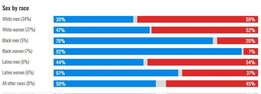
In reply I offered the following appending the image that follows):

"Charles Davidson I’m not surprised by the loss for Harris, it’s been a toss up for almost the entire race.  The magnitude of the break, that is different, although, it’s not far from a couple models that 538 did adding in the polling error typical from the last two rounds (which I was thinking were better likelihoods than what the spin was going around).


As for demographics, this gets at the reality (so far as we know it, percentage next to the demographic label is the percentage of the overall electoral that falls in that category).  I don’t have one that breaks it down along class lines.  Your point about working class and how they vote is, again, not surprising to me.  I’ve long said there’s a difference between working class and middle class, and that is too often been lumped together.  Most of the difference there is attitude and culture, but also economics.  This image shows that there’s a number of false narratives about Hispanics going around now, as with women generally, although that demographic (white women) was clearly misunderstood by the prognosticators.


What I don’t understand about Americans, rather clearly, is the depth that the majority are willing to accept the risk to our representative democratic experiment; the republic.  I have sworn an oath to defend the constitution, and the republic that it defines, having served in uniform for over two decades.  Inherently that makes me a minority, as less than 2% of Americans can or have been willing to do that.  I am, admittedly, skewed in my thinking in that regard, as I’ve taken it seriously and know what is really in the constitution and what the republic stands for and what it does not (a great example was how I, one time, revealed to you how, what you thought ought to be forbidden under the constitution, was actually an explicit power granted to the federal government under the constitution).  The rather poor civics education in our country is something I’ve spoken/written about, but to me it seems much worse than I’ve thought.  And I think it’s not just knowledge, it’s the attitudes that have emerged about the republic that have been foisted and believed, not only thanks to hyper partisanship, but downright lies and misinformation thats been bought in as well (increasingly by hostile foreign powers).  It’s really stunning and problematic if you hold to a political center based on the defense of the constitution and how it’s enshrined.  It’s also problematic when you consider the true impacts of the losses that come with having the republic falter, which most people take for granted won’t happen or blissfully ignore that it’d happen to them (again based on my experiences, especially having been to other places in the world and having been a longtime student of history).  I clearly see the risks as too great to jettison the republic, most Americans do not.  I’ve got to get my head around that.  Americans aren’t as values based as they purport to be, at least about the democratic governance experiment that came out of our revolution.  Clearly there are other motivations and drivers that supersede the republic’s defense which I thought was held more deeply in regard than it is.  I’ve got to get my head around that more and I’ll submit it is bothersome even as I am aware it’s not entirely unique to our political history."


I don't have more to add to this post, other than to say this remains tied to my post yesterday and where I am eager, for the sake of the republic, to defend it as I have sworn to do.


Wednesday, November 6, 2024

A republic, if you can keep it


I start the writing of this post in the early hours of 6 November 2024, a date that shall, I’m quite certain, be studied for many decades to come.  While the vote totals are not all in from the election balloting the previous day, it looks as if Donald Trump will return to the Presidency for a non-consecutive second term.  This may yet be overturned, but seeing where things stand with him leading in the returns of all the remaining states, it seems he and his supporters have put together not only an electoral college win, but also, for the first time ever, a popular majority win.  A truly stunning turn of events.


In 1787, as the constitutional convention was closing, James McHenry, in his published journal, records a conversation between Mrs. Elizabeth Powell and Benjamin Franklin (styled as Doctor Franklin in the foregoing):  “A lady asked Dr. Franklin ‘Well Doctor what have we got a republic or a monarchy’ – ‘A republic ‘ replied the Doctor ‘if you can keep it.’” (https://blogs.loc.gov/manuscripts/2022/01/a-republic-if-you-can-keep-it-elizabeth-willing-powel-benjamin-franklin-and-the-james-mchenry-journal/).  To be succinct, we are at a moment where that latter part will be in question.  The return of Trump to the presidency will stretch and challenge whether the republic can and will hold.  This is not a question of if or if not this is true, we have the evidence of his previous four year term to show it is true.  The question is to what degree and how badly will it be.


And that is the state of affairs that the American voters appear to have been willing to risk, if not outright endorse.  Back in the summer of 2016, I wrote about the phenomenon of Trump (http://backusec.blogspot.com/2016/07/the-trump-phenom-abridged.html), which has remained evergreen in its assessment of the nature of the supporters of Trump.  The exception being that the “feeling” aspect that drives the movement is increasingly, and almost entirely, divorced from facts or realties.  It is instead built on a set of perceptions and mythology that is repeated incessantly and through unfiltered mechanisms based on the pomposity of Trump.  Despite his being held liable for sexual assault and rape (to the tune of tens of millions of dollars)  and being convicted of a felony, his spin of it being a sham court, unjust persecution, and election interference (all of which are fundamentally untrue) are believed by a significant number of people.  Many of which are parroting or even going further in embellishing the fantasy that’s been spun out, that he not only gets away with it, people feel aggrieved with him.  The depth of how well this has permeated was brought to full relief to me when a friend commented a few months ago in response to one of my posts.  In her mind, the republic was already dead and there was nothing left to salvage from it (despite the fact that she lives in a world, which is clearly taken for granted, where the entire economy is backed by the full faith and trust in the republic she calls dead).  And the apparent result is self evident, the American voter is either wired into this dystopian version of the world or at least tolerant of it enough that they voted to put him back in office (despite well knowing the likely result).


As the first term of Trump’s presidency ensued, I prognosticated that it was going to be a chaos driven mess that was going to pull us in the wrong direction, as we had to contend with serious and potentially devastating challenges as a country both domestically and in foreign policy.  After I retired from the US Army in early 2018 it was clear that the direction was not good, but the guardrails were holding to keep the republic from failing in spite of the chaos that was beginning to be the signature of the administration, with policies issued by tweet and showmanship being the modus operandi over and against any sense of statesmanship.  There were significant accomplishments made, from the MAGA point of view:  a massive tax cut and reordering of the tax code, the appointment of a majority of solidly conservative (arguably reactionary) US supreme court justices along with scores of federal judges, a “phase 1 trade deal with China”, a bromance between Trump and Kim Jung Ill, etc.  Nevertheless, despite efforts to make our foreign affairs into a transactional system, our alliances were not fully abandoned, NATO held, and we did not fully concede to an isolationist position.  At home, repeals to the American Care Act (aka the health care act passed during the Obama presidency) failed, efforts to dismantle the civil service were thwarted, and within the Whitehouse itself, there were many who were reigning in excesses like trying to shoot protestors in the knees or using the military in domestic law enforcement.


This was, however, a serious period of back peddling and failing to address the big issues of the day, all in favor of creating political theater for entertainment sake at an unprecedented scale.  There was no infrastructure bill or serious effort.  There wasn’t any real effort to contend with entitlements in a serious way.  There was zero effort to curb spending on nice to do things and even a doubling down on wasteful efforts like the boondoggle that was and is “the border wall.”  The Afghanistan conflict continued, and instead of negotiating to leave on terms that would bolster what we had invested in that place, the Afghan government had to deal with an agreement between the US and the Taliban that put them in a horrible position; leaving the conclusion our involvement to be decided in the next administration without a real way to fix the problems.  There was no tangible effort to curb the effects of a changed global economy, and instead it was imposition of tariffs, a retake on NAFTA renamed USMCA that didn’t change the paradigm, and an era of easy cash that had hyperactive growth in the economy making it primed for a massive burst.  And, boy did that house of cards tumble in the face of a once in a century event, a global pandemic.


To avoid going on forever on the history of the first Trump presidency, it ended in devastating fashion.  Millions of Americans lost their lives to the COVID-19 outbreak, never minding the numbers globally.  The economy which was flying way to high for its own good, tanked massively putting many out of work resulting in Trump being the first president since the Great Depression who left office having lost more jobs than had been created.  The problems at the southern border never got solved (and arguably were left to fester), instead of quelling unrest and uniting the country, protests had only increased and gotten increasingly violent, and we had done nothing functionally to build a bulwark to deal with a rising China, stop Iran from getting the bomb, keep autocrats from getting their way, or strengthen our stance with allies so as to have a joint vision for security and prosperity at home and abroad.  People in America voted clearly that he had failed, and it was time to end the madness.  However, then, came January 6th, 2021, when he incited an armed insurrectionist mob to storm the Capitol of the United States, carrying his banner, to stop the certification of the election that unseated him.  Unwilling to ever concede or acknowledge his election loss, this was all fueled by a massive lie that perpetuates to this day.  He was impeached for the second time for this traitorous effort (the first was for his acts pertaining to Ukraine and the 2016 election), but as the machinations of the Senate allowed, he was not removed mainly on a technicality (making him eligible to run again).


Because of that, despite the facts and the realities of the failures of the first term of office, again he is most likely to be making residence at 1600 Pennsylvania Avenue, Washington, DC in January 2025.  Yes, the republic had not failed, but it was haggard and beaten.  Again, despite the post presidency revelations (e.g. mishandling and concealing his keeping of classified documents, efforts to get the Georgia election results overturned, and the details of his part in the January 6th attempted insurrection, among other things), the American people have elected for the first time a traitorous felon to the Whitehouse.  I have heard it many times that we need to trust the “wisdom” of the American people as the express their will at the ballot box.  I’ll be blunt, I absolutely do not, because, increasingly, it has nothing to do with wisdom.  Rather it has much more to do with the feelings and myths that we tell ourselves over and against realities we too often do not want to see.  As I wrote on social media, the election of Joe Biden in 2020 to the presidency was merely the first step in fixing the underlying problem we have in America (an important one, but still only the first step).  As is in evidence now, it was not enough to remove the head from the snake that is Trumpism.  No, we needed to address, head-on, the grievances of the electorate with a straight talking, clear and truthful effort.  Biden did some of that, in that we finally got an infrastructure bill, we took action on high tech industry efforts, we curbed the results of the post-pandemic supply chain and Ukraine war driven inflation, but it was not enough.  Biden needed to anoint his successors to keep the work going well before the spring of this year.  He needed to find a way to confront the lies and fabrications being spewed by the Trump machine.  He needed to recognize he couldn’t be the front man for any longer than the first two years and that he needed to bring home traditional republicans to a coalition that could weather the upsurge of the MAGA-ites that was inevitable to occur.  Yes, there are problems in our republic that need fixing, but Joe didn’t get at those core issues, at least enough and with the plan to get through the long slog it needs to take to get to the other side.

So now, we are looking at the question asked akin to that of Elizabeth Powell.  America will we become something other than a republic?  Massive deportations, destruction of our institutions, and much more is promised by Trump.  Those that served within his last administration, who provided some sense of guardrails, have eschewed him and what he stands for.  Loyalty to him and his fantasy world is the only mark used to judge who he lets into his circle.  So who will be the voices of reason?  It is absolutely true that Trump poses a potentially unfettered risk to the republic, he demonstrated that before and has now promised to exact revenge on any that dared to have stood in his way.  This is what was voted for, this is what we were promised.  Are we ready for the republic to end?  Can we keep it?  I have deep fears that we will not.  I have sworn to protect the constitution of the United States, and I can do no other.  Today is a day where historians will look back and ask why we chose this road.  More so they will see it as an inflection point for the unfolding story of what American became rather than what it was.