Sunday, April 9, 2023

Avoiding Lobotomy - Again


As a junior officer in the US Army, and commonly spoken in the undercurrent among both Non-Commissioned Officers (NCOs) and junior officers alike, is the “Field Officer lobotomy”(https://www.reddit.com/r/army/comments/v5taom/majors_whats_wrong_with_you/).  This is the thing that happens, somewhere in the development of an officer, typically when they are a Major, when they seemingly forget the basics of how the Army runs, and get lost into some rabbit hole while stuck in the long period between company command and battalion command.  It’s as if we just loose sense of what is “common sense” as well as being grounded in (and with) the very challenging realities of troops at the company level and below.  It’s as if all the staff and broadening “special assignments” time you spend puts you into some esoteric death spiral.  Sure you’re smart or capable, etc, but you’ve become this amorphous blob of uncertainty, indecision, and constant incapability because you’ve lost that command touch.  The vast majority of officers succumb at some point, as if they become “company men” or “women”, and accept the utter stupidity and core failings in the systems instead of seeking to work to challenge them and make for better systems or simply level with folks about the absurdity of it all.


In my military career, I worked really hard, I mean really hard, to not get/have said lobotomy.  Part of this was done by not taking the “normal path”, by eschewing just going with the flow from above as a way to get ahead.  Sure I didn’t run away from the core traditional command assignments (company and battalion command), but I found a way to do things that were impactful and as pragmatic as possible, in between.  That said, when it came to late 2016 and what I was going to do as I reached 20 years of service, I decided that micromanaging whether Johnny Joe or Jane soldier went to their dental appointment as a the way I was being measured as a commander in the Army Reserve, was ludicrous.  While it wasn’t the only reason to opt to decline a full command assignment (medical, career, and family reasons were more prominent), avoiding becoming lobotomized was also on the list.  Soldiers who served with me can tell you how successful or not I was at that task.  By summer 2017, however, I was heading to retirement, lest I succumbed.


So I am now on the cusp of yet another one of those “lobotomy” points.  In 2014 I went to the “dark side” in my career in the AEC (Architecture/Engineering/Construction) world:  I became a full time professor.  This said, I did so in a fashion that was atypical; I did not possess a doctorate.  In academia, these days, holding a PhD is normally the minimum prerequisite for such a role.  But instead I was hired to be a full time instructor and Director of the much more pragmatic Construction Engineering Management program at my alma mater, Clarkson.  If we look back at the history of engineering education, it was not until the 1970s that it became common that those serving as professors held doctorates.  Rather, it was more critical, nay the minimum prerequisite, that you had experience and knowledge that came from practice, demonstrated through licensure and robust professional credentials otherwise, rather than a having a background primarily as a researcher.  At Clarkson in particular, who’s motto is “a workman who needn’t not to be ashamed”, it was very common/valued that most faculty were consultants on the side and had a large portfolio of practical experience before and during their appointments.  Academia, for a variety of reasons, has turned to become research first, practical knowledge second, as the resume required in most settings.  And akin to the above undercurrent in the Army, it’s pretty much the unwritten rule that PhD means you have “pilled high and deep” a wall of theoretical knowledge that makes you lose the ability to have common sense or be grounded in the practical aspects of life.  And that stereotype is way too often more true than false, including a number of my colleagues in my department and beyond.


As I said, I am on the cusp of crossing that PhD line.  Not counting my chickens before they’re hatched, I still have to figure out how to get this last course done and finish the edits to my dissertation by the end of April, but the light outside that tunnel is very bright at this point.  So, if that happens, it’ll be Dr. Backus, fitting in with the crowd that is academia.  Now, strictly speaking, I did not have to pursue this.  I am a Professor of Practice at this point, something academia is finally realizing is needed; not, therefore, requiring a doctorate.  That said, there’s still a barrier to those without one to academic leadership (as was put by one person, “Erik doesn’t have a PhD so he can’t become chair, and shouldn’t remain as XO of the department”).  As I’ve seen time and time again, I’m more or less convinced that the fetish academia has with research, and the normal track for preparation and promotion for professors, is neither good nor healthy long term for the greater academy.  Running a lab, doing fundamental research, and publishing papers, does not prepare you well for become a leader of a department, school, college, etc.  And the things that are needed (eg organizational management & training, practical knowledge, leadership skills, etc.), are seen as almost anathema to gaining tenure and promotion (distractions, as one colleague put it).


So here am I, at that crossroads, about to become “one of them”, a “true academic”, with a doctorate and all to prove it.  I have no intent nor do I desire to work to gain tenure, expecting to remain a Professor of Practice through to retirement (although, I’d be very welcome, many years hence, to be considered for professor emeritus status, should that come about).  I made this pursuit, however, because it will open the doors to more senior leadership academically, given the current way things work, and it will alleviate my rather constant requirements to correct students from referring to me as “Doctor Backus” when I don’t have one.  I have always been a deep and big thinker.  I love learning, I remain ever curious and interested in expanding knowledge.  So I am not allergic to research (there’s parts of it I really like) and have been doing research even as far back as my Masters and in other roles in the military and when I was a practitioner in facilities organizations.  But I really think studying the ability to generate electrical power from lobsters (https://improbable.com/2013/02/06/renewable-power-source-search-lobsters/ ), while novel and cool, is utterly impractical and I am really not that interested in it.  I’m not saying that there isn’t a need for researching such things if they can lead to some real breakthrough, but it’s not my bag.  And to that, I hope it never becomes “my bag” as I stay rooted in the much more pragmatic, like making sure my students actually know how a toilet works, have had the experience of actually hammering a nail, as well as being able to do structural analysis, understand how to do concrete batch designs, size heating and cooling equipment, and build safer, better, and more resilient/sustainable infrastructure & buildings. I just do not want to be lobotomized away from what my experience and continuing practice allow me to do to bring value to my students, in the immediate sense, and through them, for the broader AEC community as a result.


I am going to say, hitting this milestone is something I remain sheepish and humble about.  The resume, so long as things finish as they should, will now list getting a PhD in 2023 (long removed from my Masters in 2004, so a late return to getting a terminal degree).  I will remain a bit of a unicorn, not fitting in exactly and pushing back against the consensus on what the broader academy needs to look like to remain relevant.  I do not believe one can be “over educated” as some seem to think happens here, when you’ve done a pursuit for a doctorate.  But I do get that we cannot and should not stare down our noses or exhibit the too often seen elitism that comes being in an academic ivory tower (evidenced just this week as senior academics poo-pooed the idea that a long-term decades-experienced, successful senior manager in the AEC world was not capable of teaching a masters level course in the “business of construction”, because he lacked an advance degree in business).  And I think engineering education, in particular, needs to return more to the practical, hands on, even trade skill training and education, that keeps us rooted.  I just don’t want to fit the moniker, I don’t want to be unable to relate to, empathize with, and understand the plumber, carpenter, iron worker in the field.  To me, being at the top of what I do means I help tomorrow’s construction (and, more broadly, AEC) leaders, grow in ways that brings better solutions than we come to today, working together and respectfully across backgrounds and experiences.  I just can’t succumb to a PhD lobotomy, in other words.  To that end, I hope those around me keep me grounded accordingly.

Saturday, January 14, 2023

“Free” stuff just isn’t free, and we need to stop using that term


“Free” stuff just isn’t free, and we need to stop using that term


Over the last several years, with increasing abandon, the term providing “free” things has been a central theme of American political discourse.  For instance Bernie Sanders maintained (and is still maintaining a) pledge to “Make Public Colleges, Universities, and Trade Schools Free for All”.[i]  There’s been calls to make health care “free” and universal.  Even the US government provided COVID-19 vaccines are said to be “… free and available to anyone who wants one.”.[ii]  Here is the thing, however, they are absolutely NOT free.  Higher education, for instance, costs tens of thousands of dollars per student annually.[iii]  Health care represents approximately 20% of the US GDP, which represents over $4 trillion of the US economy.[iv]  Simply put, these things cost something and have enormous value.  Last I checked, money doesn’t grow on trees and there is a severe limitation for how long we can just print money before it has larger economic implications (e.g. becomes worthless).


Front cover of the seminal text on the issues with “Free” Parking[v]


Besides those realities, the whole mentality of making something “free”, that really isn’t, is massively detrimental.  The quintessential example of this is the affliction that “free parking” has had on the US in particular, but broadly across the globe.  In his over seven hundred page text (cover pictured here), Donald Shoup, PhD., lays out in excruciating detail how, despite the moniker, “free parking” is exceptionally expensive.  He puts into specific relief the costs to society and to the individual that is a part of a place and system that employs the paradigm that is “free parking”.  And he makes the case, strongly, that part of the “high cost of free parking” is that it has created perverse and spiraling incentives that only create more costs and more damage.  He lays out how the mere fact that people believe it ought to be free, as if it was a right, is massively damaging in two distinct ways:  1) that the ones paying for it are not even often aware how much or how imbalanced it is for what they get and 2) it creates the illusion that there is not an incredible amount of value (sunk or otherwise) in the provisioning of said capacity.  In other words people take it for granted and people don’t have a clue about the bill they are actually being forced to pay for it.  He lays out, as a set of prescriptions, that we make it transparent how much it is costing and reform the systems in place to align usage to who pays for it, equitably, in the marketplace.  In this sense, what is “free parking” would be an ever more appropriately called “taxpayer subsidized” or “taxpayer provided” parking.


This exact analysis translates to any government provided service or provision of goods.  They are not “free”.  Someone is (or someones are) paying for it.  Even if you don’t have to pay directly for it at the point of service, its still not “free at the point of service”, its “provided to you by the taxpayer” or “provided to you on account of your being a taxpayer”.  We simply need to expunge this notion of things being “free”, because the only real things that are free are those natural and inalienable rights that simply are a part of being.  And to that, this incessant need, especially on the political left, to make things free, or assert a “right” that is anything but, really diminishes the value of what it is that they are advocating for.


I am all for the idea that we have a social compact that is managed and facilitated through the government as the final arbiter.  I further believe that it could be a good thing, for instance, to support a drive to fully taxpayer provided post-secondary education (tied to a national service requirement, military or otherwise) as a potential model.  It cannot nor should not, however, be considered “free”.  We need to get our heads around the fact that there are things that are common goods that necessitate contributions through mandatory efforts (we did NOT fight a revolution against paying taxes; we did fight the revolution to end paying taxes we did not have a say in imposing on ourselves[vi]).  It is a necessary thing, for instance, to promote and ensure that the demos in a democratic republic, are educated sufficiently to self-govern themselves.  Relying on secondary education as the only requirement in a lifetime to achieve that need, as the majority proportion in society, is no longer sufficient.  Trade schools, higher education, and other certification or education pathways are needed.  It is everyone’s responsibility to ensure this happens, not just those that choose those pathways.  And we ought to be clairvoyant enough to call it like it is: taxpayer subsidized, taxpayer supported, and/or taxpayer provided (depending on the level of fiscal support provided to the program).  Likewise, if we choose for universal pre-K or healthcare or what ever other program we enact or service that is provided.  Its not free.  It costs something, it has value, and it is a part of what we pay for as citizens.


So, stop it with the “free” mantra.  It’s a falsehood.  Get on with meeting our responsibilities as taxpayers and being clairvoyant about what government can and does for us.  After all, that is what we are paying for, whether we know it, like it, or not.


[i] https://berniesanders.com/issues/free-college-cancel-debt/, accessed on 2 September 2022

[ii] https://www.vaccines.gov/, accessed on 2 September 2022

[iii] https://files.eric.ed.gov/fulltext/ED498601.pdf,

[iv] https://www.cms.gov/Research-Statistics-Data-and-Systems/Statistics-Trends-and-Reports/NationalHealthExpendData/NationalHealthAccountsHistorical#:~:text=U.S.%20health%20care%20spending%20grew,For%20additional%20information%2C%20see%20below., accessed on 2 September 2022

[v] For short synopsis of this 700+ page text, you can read it at this link:  https://www.researchgate.net/publication/235359727_The_High_Cost_of_Free_Parking

[vi] Further, despite what the talking heads and politicians keep professing, we live in a democratic republic, which we, as citizens, are the ones going in the voting booth to have a say about.  It is only because, “we the people” have let them get away with it, that we have the results that we have and the obfuscations are so thick.

Sunday, June 5, 2022

A Tribute to Dale

A Tribute to Dale 


For those not following me on social media, you should know that this weekend, we put to rest my brother-in-law Dale Elster.  Dale’s life was cut short in the earliest morning hours of May 31, 2022; Dale was 56 when he passed.  Dale was not without his ailments and health issues, but the proximate cause of his death was not any of those things, as it seems.  His wife, my spouse’s sister, woke up to him having a seizure in the middle of the night, and beyond that I wish not to delve further.


His daughter, my niece and god-daughter, asked in a Facebook post that we share a story about her dad so that she might have a collection of such remembrances to look back on to keep his memory alive for her and all of us.  As I posted there, it would take a bit to do so, but I would acquiesce to her request gladly.  To that end, what follows is both story and tribute to a very special human being whom I was privileged to know, in a unique way.


Let’s start then with the story of the first meeting.  I had been in a relationship with my wife of 24 years, for going on 2 years, I think, when the occasion was available to meet both her sister, Jannette (Jan) and her long-term boyfriend at the time, Dale.  They were living in an apartment in Auburn, a converted garage, and the entertainment of the evening was watching the retro-hit: Emergency!  As a group of Gen-Xers, we just delved right into the heart of the part sit-com/part drama that was the show that ran for 6 seasons, stepping back into our youths and the way TV had been.  Dale, having lived in SoCal, actually knew some of the places in question, and “Station 51”, “Rampart Hospital” and doing things “stat” were all familiar to us.  All I really remember, besides the TV viewing, was how I just liked Dale.  Dale just had this way of making you at ease, even when you might otherwise stress. He also had a true US northeasterner biting sarcasm to boot.  It wasn’t so hard a bite that you resented it, but it was the kind of chiding that you could really appreciate.


Several events passed, including the passing of Al Clifford (Jackie and Jannette’s father), their wedding (which they were kind enough to let me escort my still girl-friend at the time, Jackie), Baldwin family events, and much more.  To be succinct, marrying into the Clifford/Baldwin clan was not for the faint of heart.  First, you had Dan and Andrew, Jan and Jackie’s brothers, who were separated by a bit (5 years) from Jackie and (8 years) from Jan.  Both were in prime adolescents at the time and challenged by the declining health of their father.  Then you had the fact that Jill, my mother-in-law, came from a brood of children from Cato, NY, too many to count, that made any Baldwin family gathering a true test of your ability to match names with faces (often being reminded there was going to be a quiz at the end).  And lastly, as the only two sons-in-law to two very strong Clifford women … well let’s just say we had a ton in common.  I won’t say that Dale, in all these things, was my “wing-man” but often we were able to get in a few side moments where we could compare notes, commiserate as well as celebrate the choice in life-mates/families we had made.


That and the many other things we shared.  Like Jackie and I, Dale was a fan of Star Trek, and especially Star Trek:  The Next Generation.  The fandom of this Gene Rodenberry inspired Sci-Fi franchise was really core to us.  We would often criticize or appreciate the next installment, reboot, or reinvention.  But I also appreciated that we were not so parochial about Sci-Fi generally that we couldn’t appreciate the other franchises that were vying for our attention, including Star Wars and many others.  That said, many a beer was cracked open by the USS Enterprise bottle opener I bought him one Christmas.


Speaking of beer, and this is another thing that we had in common.  Dale was, and always remained, at first, at Chef.  Sadly after managing to hack off a finger or two too many (more on that later), he was put on long-term disability.  That, however, did not stop him from trying to be inventive/creative and making a go at the home-brew world.  Dale understood, I think, the value of how a beverage of a unique character, like wine, a mixed drink, or malt beverage, could pull a meal together.  While not adverse to wine, either of us, he took to brewing as his outlet for how to make a meal complete.  What was great about “Dale Beer” was not only the fantastic brew, but the artistry of the label.  He had a knack for figuring out how to make something unique, without it becoming an over hopped nightmare or yet another fruity R’ us concoction.  And then he came up with a great name and an even better label.  Among his most famous was the “Dale’s Incarcerator Double Bock” (named for Auburn’s state prison) as well as his “Gunpowder Porter”.  Being a fellow “beer snob” we’d really get into the discussions on his creations and what was happening in the market generally, as the micro-brew craze was just taking off.  To that, one evening, I said I thought that the idea of a single bock with a lime zest might be a real awesome brew.  Some months later, as I returned home from a combat tour in Iraq, Dale took the special effort to create “Backus Bock” from said discussion.  It’s not often that you find a brother-in-law that literally makes your favorite beer, but that was Dale.


There were countless other areas we converged, even as we had others we diverged.  He was a true workingman who had experiences coast-to-coast; I was from a family of working people and teachers, who were deep in the construction industry.  So in part we knew each other, but it was different.  I was a military veteran, and Dale was a veteran of life, often times not the easiest to him.  I mentioned the chopping off a finger or two above, and one of those places we diverged was his love of the horror genre.  In part because I have seen the realities of gratuitous violence in war, and in part because there are other reasons to be scared, I just couldn’t engage in that part of his world (even as I was exceptionally appreciative to be a part of his horror writing career).  Another was on faith/religion, where I am a fairly religious person, Dale more or less eschewed faith.  That said, I must be candid in saying, this was never a point of all-out division, but rather a mutually appreciative set of perspectives.  Dale, in my estimation, was a deep humanist, or perhaps humorist is more apt.  Having him be a part of the baptism of his children and several other religious rituals, was, I think a part of his ability to navigate a middle way, even absence any proclivity to belief on his part.  He respected that which he did not have himself, and to that, I was very respectful of his critiques, thoughts, and divergences, even as I did not hold to the same.


Finally, there is the part which was the “true Dale”.  Dale was not flawless, he knew it.  He had his issues, his problems, his own foibles, and that was who he was.  That said, he was at all times generous.  And in generous, I don’t mean financially, albeit that might be how too many Americans might take the forgoing statement.  No, he was generous in being humble enough to know that if he had problems others did too.  He gave time, space, and opportunity to those around him to be heard and to be able to know he was “in their corner”.  Now this didn’t mean he wouldn’t cut you down in a joke or some other sarcastic remark, that you more often than not needed to hear.  But what I am talking about that Dale was generous in his love.  Now I can wax poetic about the kind of love that he exhibited (cf. The Four Loves, by CS Lewis), but Dale hit them all, depending on who you were and what you needed.  And that was Dale’s special magic.  He knew love, he knew the brokenness, and his response was not to give up, not to give in, but to embrace, even in a cutting satire, what we need(ed) to hear.


On my own part, it is going to be hard to be back for family events without Dale.  He could be a rock or at least a sounding board.  He was the kind of man that loved his family and they loved him.  This will not stop, nor should it.  He is gone in the corporeal sense, but he is alive in our memories, in our loves, and in our sharing with one another.  Dale, it is my sincere hope that the photon torpedo casket that we just sent you out on, lands in a strange new world, one that no one, and no being, has ever seen or appreciated as much before.


Monday, June 28, 2021

Economics and Data – Real Unemployment and Labor Force Participation


Economics and Data – Real Unemployment and Labor Force Participation


On June 6th, as part of his regular segment called “data download” Chuck Todd of NBC News and Host of “Meet the Press” highlighted a stark reality as it relates to our current labor situation, that our Labor Participation Rate in June 2021 is no different than it was in June 1977.


Take a watch and listen to this video:


I have been saying for some time that I strongly believe that our (the USA’s) economic fundamentals are really off kilter (“screwed up” as I put in in some posts).  To me there are several measures that I look at to see what the overall health of the economy is, and they aren’t’ what typically get rolled out in the general media coverage of how things are going.  You know the measures put out there:  GDP growth, unemployment, stock market growth, size of the federal annual budget deficit, overall trade deficit, quarterly earnings, and so forth.  These are “ok”, but they really are too gross to get a real picture of the economy and its health across sectors and effecting most of us.  I won’t go over many of these now, and what a good analysis says about them, but some of the time based trends I carefully watch are:

I look at them not only in terms of their own meanings (which can be significant), but also in comparison with one another.  And if you look at all of these, you will start to see a picture that isn’t healthy for the long-term, and we really need to have a plan to address many of the problems therein.

The one I want to focus on here, however, is specific to employment.  For some time now it has become too fashionable to determine how “normal folks” are doing by looking at the unemployment rate.  If the rate is in low single digits, the media, politicians, and seemingly everyone believes that the economy is doing great!  If it creeps above 8% or more, especially if it goes double digits, the reports are that the economy is in the toilet and that folks are suffering massively.  Here is a chart tracking the unemployment rate over that last couple decades in the US (2001 to 2021):


[i]

Here is the thing though; the unemployment rate is a very short-term measure of things.  This is because the term “unemployed” is a very loaded term.  Here is that definition according to the Bureau of Labor Statistics:

“In the Current Population Survey, people are classified as unemployed if they meet all of the following criteria:

• They were not employed during the survey reference week.
• They were available for work during the survey reference week, except for temporary illness.
• They made at least one specific, active effort to find a job during the 4-week period ending with the survey reference week (see active job search methods) OR they were temporarily laid off and expecting to be recalled to their job.

People waiting to start a new job must have actively looked for a job within the last 4 weeks in order to be classified as unemployed.  Otherwise, they are classified as not in the labor force.”[ii]  And, the “unemployment rate represents the number of unemployed people as a percentage of the labor force (the labor force is the sum of the employed and unemployed).  The unemployment rate is calculated as: (Unemployed ÷ Labor Force) x 100”[iii]

Long and short, if you’re reading carefully, the term “unemployed” does not mean the sum total of all those that are “out of work”.  No, it is a very limited sub-category of those that are “out of work”, given that it omits anyone that has been determined to no longer be in the “labor force”.  So while “unemployment” may have a low percentage, there could still be a large percentage of folks not working, aka “out of work”.  So, how then do we figure out what the reality is in terms of who is really “out of work”?  To get at that, we need to get at the Labor Force Participation Rate.

The labor force participation rate (or participation rate) “represents the number of people in the labor force as a percentage of the civilian non-institutional population. In other words, the participation rate is the percentage of the population that is either working or actively looking for work.  The labor force participation rate is calculated as: (Labor Force ÷ Civilian Non-institutional Population) x 100.”[iv]  Imbedded in this is the idea of the civilian non-institutional population, which is the “population age 16 and older… published by BLS … [excluding] the following:

  • active duty members of the U.S. Armed Forces
  • people confined to, or living in, institutions or facilities such as
    • prisons, jails, and other correctional institutions and detention centers
    • residential care facilities such as skilled nursing homes

Included in the civilian non-institutional population are citizens of foreign countries who reside in the United States but do not live on the premises of an embassy.”[v]  So, basically, this rate is the percentage of civilian people in the country that could, potentially, work.  It will never be 100%, as it still includes folks that are not likely to be working anyhow, namely (and these are just some examples):
• retirees
• students still in school, including those finishing high school (typically through age 18) and in college
• those on long-term disability but not in a residential care facility
• those undergoing temporary medical treatments, that may last a long period of time
• those that just don’t want to work by choice

So what does that rate look like over time?  The following is a chart of the Labor Force Participation Rate since the end of World War II:


[vi]


As can be seen in this chart, prior to the mid-1970s, the rate was somewhere between 58 to 60%.  Another way to look at this is that roughly 40% of the civilian population was not in the labor pool.  Social mores up until that time, often precluded women from pursuing careers and often were not working, yet were certainly part of the “civilian non-institutional population”.  Given that women make up 50.8% of the population[vii], this means that a large part of that 40% was likely to be women.  Women taking on a more vigorous role in the labor force should have seen a significant rise in the participation rate.  The rate, however, by the mid-1990s, more or less stayed in the 66 to 67% range; a nominal 10% rise to prior to the widespread of women entering the workforce.  This means we still had about a third of the potential labor pool not working.

Since 2000, this rate has been in decline; the point being that the percentage of the labor pool that is working is shrinking.  People have simply moved from “unemployed” to “not in the labor pool” at a seriously concerning rate.  Yes, when we see a spike in unemployment rate, which is bad.  However, even if the unemployment rate is low (as we saw from 2002 to 2007) it does not mean that the labor participation rate is increasing or recovering (as we saw from 2002 to 2007, where it, basically, continued to drop and settled at a new lower rate).  Moreover, even when there is an economic expansion (defined as a growth in GDP), does not mean “average folks” are seeing the benefit of it.  If you look at this, then you should be getting a clearer picture why there is increasing dissatisfaction both in the political and economic arenas, especially for those that have heretofore taken it for granted that the American dream provided for a good paying job, in their hometown, doing something that their parents, grandparents, and generations before had done.  This just is not the reality, and instead of unleashing the power and potential of the fullness of women in the workforce, we have missed a huge opportunity.

One might say that the economy does not exist to create jobs for people.  I’d say that an economy that isn’t taking advantage of its human capital to the maximum justifiable extent (we shouldn’t be forcing 80 year olds to work), is truncating the opportunities not only for those out of work, but for the potential of the collective economy to strive.  Having never broken the 70%, mark in the participation rate, given the widespread entry of women in the US workforce, is telling of some significant problems long term.  And, when brought into the context of the rest of the statistics I mention above, it is certainly a clear reason we need to rethink our economic approach in the not too distant future.


Tuesday, December 15, 2020

Blessed Kateri


So today is a tough day in a tough year.  We are going to have to say goodbye to a very special part of the family, our pet cat Kateri.  She was and will remain a part of our hearts.  Like Nutty, our first pet together, Kateri has been a live action partner through quite a lot of challenges.


So where to begin?  Well, lets start with her name, Kateri, for Kateri Tekakwitha, the fairly recently canonized patron saint of the environment and ecology, the first canonized native person for the continent we call North America.  Our Kateri was born in a litter of kittens in July 2004 to a family of devout Roman Catholics that had befriended Jackie while I was away on my first deployment to Iraq, the Hamachers.  Belen and Paul were wonderful people, with Paul finishing out his service in the Air Force by commanding the AF ROTC detachment at the then named University of Missouri-Rolla (now Missouri S&T).  They had purchased and rented a small farm north of town given their rather large family, making space for a few pets in the barn or garage was normal.


The Hamacher children named the kittens for Catholic saints or blesseds that were commemorated around the date of their arrival.  Kateri (so named because the feast day of the, then, Blessed Kateri was July 14th) along with her long haired tabby colored brothers and sisters needed new homes.   Having returned recently from Iraq after a 14 month tour, Jackie and Nutty were very intent on having another feline partner in the mix.   So after a visit out to their home for breakfast, and after observing the rambunctiousness of the tree climbing longhairs, we were smitten, and Kateri was on her way home with us.


Kateri from the outset, was what I would call a “troublemaker”.   You see our other cat, Chestnut, Nutty as we called her, was the alpha of the two, but Kateri was not about to let that get in the way of her “counting coups” nearly any time Nutty went by.  And I mentioned that amazing tree climbing ability (Christmas or otherwise), well one weekend, not long after we had gotten Kateri, she escaped out the front door on Jackie and decided to run up a nearby tree at the edge of the woods near the duplex we rented in Rolla.  The problem was I was, of course, at Army Reserve drill some 45 minutes away at Fort Leonard Wood, and I didn’t have an extension ladder at the time.  So after rushing back home, renting a ladder in a pinch on a Saturday afternoon, I rescued our small, shivering and scared, Kateri kitten from her own treetop prison.


Kateri, as I said came to us in 2004, and at the end of that year, I defended my thesis and graduated with a MSCE from Rolla; we were then on the move.  This was our first civilian move, I now being in the Army reserve, but my job was taking us from Rolla, MO to northern Virginia, just outside Washington, DC.  The cross country trip was a two day drive affair, and we opted to split up, with myself and Nutty in the advanced party and Jackie and Kateri in the trail party.  I flew out to Saint Louis to help with the second drive east.  Unlike Nutty who was not a great traveler, we soon learned here that Kateri was the one that could always roll with the punches.  We also had it reinforced that if there was the possibly the most uncomfortable position to lay down or otherwise find herself, she did so.  This often included the upper area above the trunk in the Dodge Stratus that Jackie was driving at this time, or flopped over the  center console that made getting a cup into the cup holder a challenge.


For the first year in Virginia, we lived in a nice single story “rambler” (aka ranch) home in a nice wooded neighborhood that had a full size tennis court in the backyard and a really nice wood fireplace sunroom/family room that Kateri and Nutty made their own, but Kateri was especially grateful for the bookcase she was able to crawl into an nestle into, and the backyard full of leaves and branches that would inevitably be stuck to her tail.  She also more than proved her worth with her keen mousing, which Jackie and I greatly appreciated a couple time through the years.  Sadly, we couldn’t buy the house we were renting, so we found a nearby townhouse and a year later figured out a way to get all of our stuff and the two cats into it.  Before we moved our stuff in though, we took the cats over and let them get in their first prowl.  Nutty, being prim and proper, checked out the rooms and so forth, but Kateri, she headed straight for the basement, and figured out how to cover herself in cobwebs.  That also was Kateri, her long hair meant, to her at least, it was purposely for capturing whatever debris it could.  With the hope to be able to display the most disheveled appearance possible.  Inside or outside, she would constantly pick up leaves or cardboard flakes (from some scratching device or another), or some other foreign object.


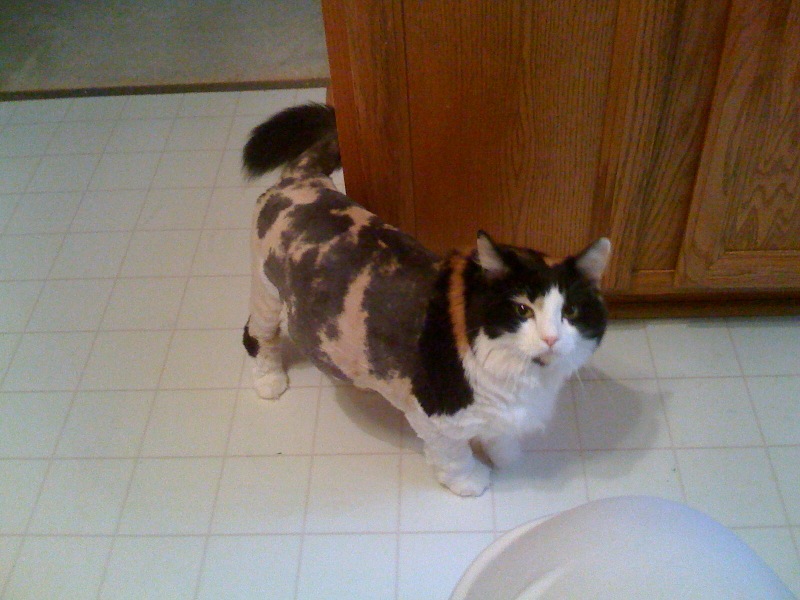
So, grooming a long haired cat is a task that is not to be taken lightly.  And it was a constant necessity.  Kateri, however, was simply not a fan of the process.  Jackie and I would be able to get in like 3 strokes of a comb or other grooming device before we would incur her wrath.  In the summer, Missouri’s and Virginia’s being warm, would often result in her fur getting matted and creating hot spots that, if not removed, would cause her real pain.  But getting them out, now that was a battle.  We eventually took to doing a summer shave, “lion cut”, to help her wade through.  Invariably, out on the patio, the day we would do this, it was a scene of fur and screeching and scrapes (mainly on Jackie and I) and a cat transformed.  A few times we were able to get a local groomer to take the mantle of this effort, and I think Kateri and us both agreed that was the better way out.


Kateri, as I indicated, was a flopper, almost anywhere and any way, but she also loved to curl up like a ball, and lay on top of Jackie.  At night, especially in winter, if Kateri wasn’t in her “Tuft” cat bed, she was laying out on top of Jackie.  Nutty would like to lay on my chest or next to us, but Kateri had claimed Jackie as her own and best bed spot.  Given her name and this clear preference for Jackie, I’d tease her as being the “Catholic cat” to Nutty as the “Lutheran cat”.  And there was a bit to all this as Kateri with her grooming needs, could certainly pour on the “Catholic guilt.”  The only other place you can always find a cat, and Kateri was no exception, is in an open cardboard box.  So much so that its probably no surprise that her second favorite spot was in one of our paper recycling boxes or what ever new package arrival was left for her to climb into.


Holidays, when we were living in Virginia were nearly always a drive back to the Syracuse/Auburn area in NYS where our families were located.  Most years we would opt to take the cats with us.  When we were in Syracuse, they were more or less confined to the second floor at my parent’s place.  But when we got to Auburn, on account of Jackie’s mom’s small apartment, the cats became guests of the Elster’s, often for almost a week.  Nutty always the less adventuresome, stayed to the main house, but Kateri, nope that wasn’t enough. One time she had to crawl through the the utter bowels of the basement, covering herself in cobwebs and lint and whatever else she could find.  And despite being allergic to cats, Dale Elster, our brother-in-law, became enamored with Kateri and the two were often best buds each year.  Sadly, after Christmas in 2013 (a year we didn’t take the cats with us), we came home to see that Nutty had a respiratory issue which led to us having to put her down in early 2014 (for more, see Tribute to Nutty here:  http://backusec.blogspot.com/2014/01/tribute-to-nutty.html).  So Kateri, who always had Nutty as the leader, was now running solo.  By now she had grown into her “go with the flow” existence and being the alpha cat just wasn’t her bag.  But she did her best to cuddle into laps like Nutty did and be our prime home comforter.  Later that year, a fateful decision made, we were on our way to northern New York State, and Kateri was moving (returning if there is karma involved) to the land of her namesake’s people.


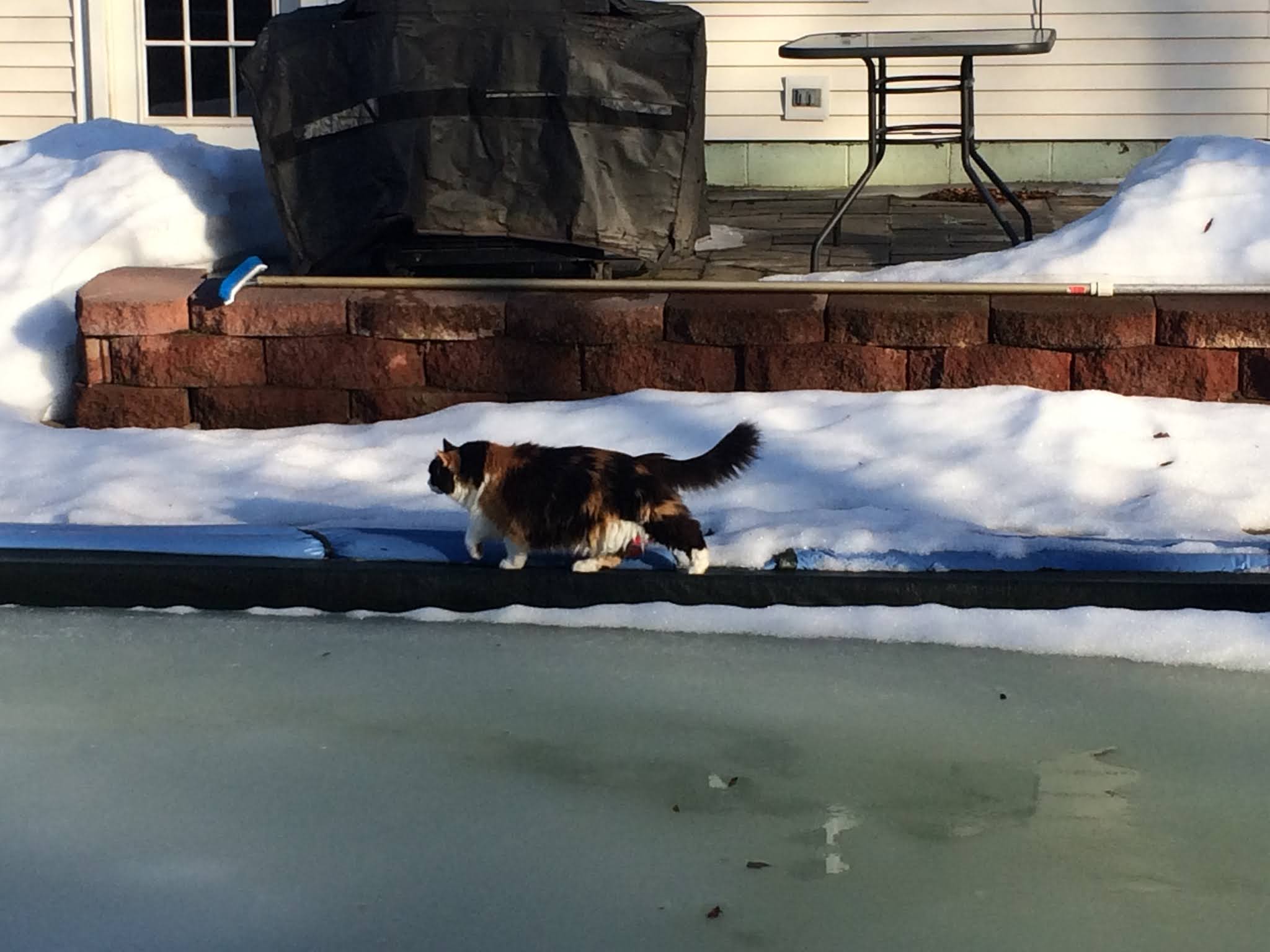
Now Missouri and the DC area have some snow on occasion and sometimes its heavy, but here in the north country of NYS, where there are more cows and deer than people, Canada is a mere hop, skip and jump away, and ice hockey is THE sport, umm, snow, its like here.  And not to subtlety help us in remembering this fact, as we were returning to our mutual alma mater’s at Clarkson University, the first winter back was a return to the bitter snowy cold we experienced back the 1990s (climate change had been inching the thermometers up for some time, to the point that ticks and lime disease, never seen in my youth this far north on account of the historic cold winters, are a serious issue).  Kateri features in as, undeterred, and by now a bit heavier on account of her age and taking full advantage of self feeding, jumped out to experience the winter snows fully.  She was so insistent on going out onto our patio area around the backyard pool, that in the winter I would shovel a “run” for her to be able to get out and about.  She really thought about being a permanent outdoor cat, but the aforementioned ticks and her age, well, it wasn’t going to happen, even when an unexpected guest arrived.


Pepper, a new kitten who joined the family in the summer of 2015, was Kateri’s next challenge.  Kateri, never taking the alpha position, was just not happy having Pepper around and growled in her general direction any chance she could.  After all she had ruled the roost for a year or so and here was the young whipper snapper that was in her space.  With the help of some felaway feline scent treatments, eventually Kateri was able to cope.  Wrestling matches still ensued from time to time, but the whole big house, big yard world gave Kateri enough space to get away as she needed to.  That, and by now, her flopping was often on top of the toad stool just inside the living room window or on the shelf in the bedroom where she could bask in the sun, her favorite pastime.  Life was good, summers by the pool, winter romps in the snow, sleeping on Jackie at night and sun bathing by day.


And that brings us to the last couple years, age had begun to show.  Nutty lived from 2001 to January 2014, 13 great years.  This past July, Kateri went over 16 years old.  As age took her, things began to show.  First, it was a lot of fussiness over the litter box and occasional over sprays or urination on the tray we put in place around the box for such problems.  Bespeaking her joints didn’t quite want to crawl over the ever shallower litter box edge anymore, we started a regimen of antinol pills at dinner.  It was also fussiness about food, and weight loss.  We changed diet, went back to self feeding (to which Pepper has taken advantage and needs to trim up a bit), and other strategies to get her back her mo-jo.  Then the vomiting began, something we attributed to her love of eating grass in the summer as she went out (and of the cat grass we would provide in pots in the winter for her), but it became more chronic and with or without grass eating involved.  And then it wasn’t just urination outside the box, it was #2 as well, to the point that she was using the co-located “puppy pads” much more often than the box, if she used the box at all.  She was old, we thought, things happen.  But after some blood work of late, it was clear she had liver disease and it was getting worse.  With a newborn child, Emily, joining us in early November this year, she really took a more serious dive, so we got a check and we tried another diet change and added some new medications, but ... well it was clear her GI track wasn’t recovering and wasn’t likely to rebound.


As we learned with Nutty, cats tend to hide their conditions for a long time.  There was also the factor of loss of vim and vigor, even for things that she really loved in the past.  It was just hard to see her suffer in the long term.  Her fur wasn’t the same and it was just time to make the ultimate decision.  So, not wanting to put it off until after Christmas (after all losing Nutty when we came back from the holidays was a real bad way to start a year), and it being 2020, the year of less than optimal circumstances, we made arrangements and today, 15 December 2020, was the day.  We’ve been melancholy since this weekend, knowing we were going to call on Monday to set the day, and today has been hard.  Emily is bubbly as ever and a wonderful joy, but it just can’t make up, today at least, for the hole we were going to create in our hearts for our long haired tabby friend.


So the title of this post, takes its cue from Kateri’s namesake, but I can’t seem to get a song out of my head, one I know many have heard and find hope in, as do I.  “Blessed assurance, Jesus is mine; O what a foretaste of glory divine; Heir of salvation, purchase of God; Born of His Spirit, washed in His blood.”  I know that death is a part of life and that God is in the midst of all pain and joy and love and sadness.  So this is not the final end, her memory is in ours.  Earlier this summer, Jackie created little flip signs so we could keep track of when each of the cats was outside, and for Kateri’s it has a picture of her flopped in an upside down umbrella and the caption “Out adventuring” for when she would be out on her loved patio; now flipped to that side forever on the back door.  There is no doubt she is indeed adventuring somewhere, eating the grass she loves to chew, and enjoying more of the shrimp dinner that I shared with her last night.  We are going to miss you Ka-tear.


Blessed Kateri, feline of ours

O what a companion, of both of our hearts

Cuddle-er of Jackie, fur that’s a mess

Born in Missouri, always in our love


Love, your humans.